Among the more technical tools in astrology, Arabic Parts—also known as Lots—stand out as a fascinating bridge between ancient methods and modern techniques.
They are:
- Mathematical points
- Derived from planetary relationships
- Used for highly specific topics (fortune, marriage, death, etc.)
While often associated with medieval Arabic astrologers, their origins are actually older, and their logic closely parallels a modern technique: midpoints.
1. What Are Arabic Parts (Lots)?
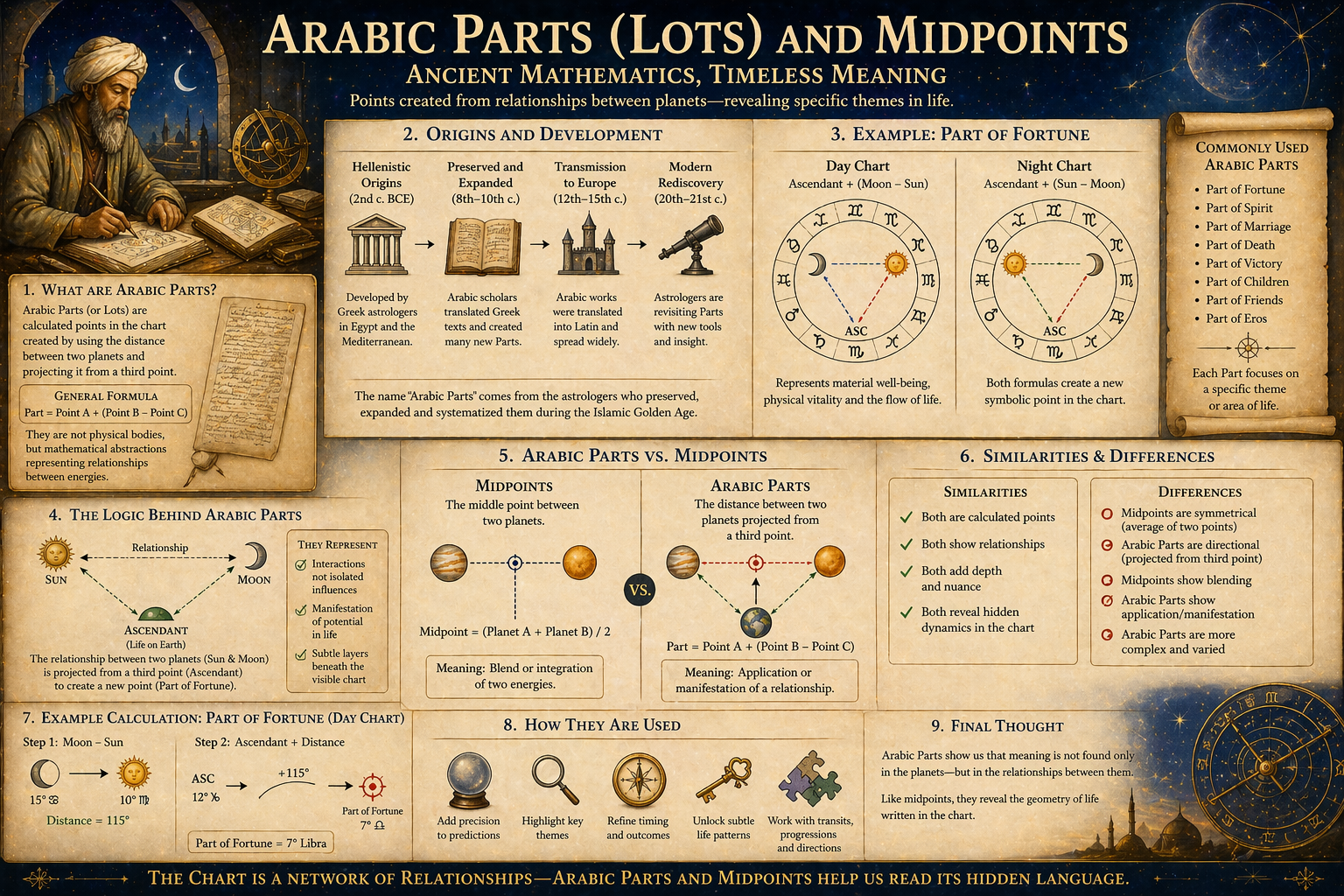
Arabic Parts are calculated points in the chart created by measuring the distance between two planets and projecting that distance from a third point.
General Formula
Part = Point A + (Point B – Point C)
Most Famous Example: Part of Fortune
Ascendant + (Moon – Sun)  [Day chart]
Ascendant + (Sun – Moon)  [Night chart]
This creates a new symbolic point representing:
- Material well-being
- Physical vitality
- Flow in life
2. Origins: Hellenistic, Not Just Arabic
Despite the name, Arabic Parts were not originally Arabic.
True Origins
- Developed in Hellenistic astrology (2nd century BCE onward)
- Used by Greek astrologers in Egypt and the Mediterranean
- Later preserved and expanded by Arabic scholars
Why They Became “Arabic”
During the Islamic Golden Age:
- Greek texts were translated into Arabic
- Astrologers expanded the number of Parts dramatically
- The system was systematized and transmitted to Europe
Key Contributors
Arabic astrologers:
- Formalized hundreds of Parts
- Applied them to specific life topics
- Integrated them into horary and natal astrology
3. The Logic Behind Arabic Parts
Arabic Parts are based on relational geometry.
Instead of looking at planets individually, they examine:
The relationship between planets—and project that relationship into a new point
Conceptual Breakdown
- Sun = identity
- Moon = body/emotions
- Ascendant = physical life
The Part of Fortune combines these into:
A point representing how life “flows” physically and materially
Key Insight
Arabic Parts are not physical objects—they are:
- Mathematical abstractions
- Representing interactions between forces
4. Why So Many Parts Were Created
Medieval astrologers developed hundreds of Parts, such as:
- Part of Marriage
- Part of Death
- Part of Victory
- Part of Children
Reason
Astrology needed:
- More specificity
- Topic-focused analysis
- Predictive precision
Arabic Parts allowed astrologers to:
- Isolate themes
- Refine interpretations
- Answer targeted questions
5. Relationship to Midpoints
This is where things get interesting.
Arabic Parts and midpoints are conceptually very similar.
What Is a Midpoint?
A midpoint is the exact halfway point between two planets:
Midpoint = (Planet A + Planet B) / 2
Example
Sun/Moon midpoint:
- Represents integration of identity and emotion
6. Key Similarities
1. Both Are Derived Points
- Not physical bodies
- Calculated mathematically
2. Both Represent Relationships
- Midpoints → balance between two planets
- Arabic Parts → directional relationship between three points
3. Both Add Interpretive Depth
They reveal:
- Subtle influences
- Hidden dynamics
- Secondary layers of meaning
7. Key Differences
1. Structure
| Technique | Structure |
|---|---|
| Midpoints | Symmetrical (average of two points) |
| Arabic Parts | Directional (distance projected from a third point) |
2. Symbolism
- Midpoints → blending or fusion
- Arabic Parts → application or manifestation
3. Complexity
- Midpoints are simpler and more uniform
- Arabic Parts are more varied and context-dependent
Diagram: Arabic Part vs Midpoint Concept


8. A Deeper Interpretation
You can think of the difference like this:
Midpoints
“What happens when two energies combine?”
Arabic Parts
“What happens when the relationship between two energies is applied to life?”
9. Why Arabic Parts Fell Out of Use
In modern astrology, Arabic Parts became less popular because:
- Too many were created (overcomplication)
- Difficult to calculate manually
- Rise of psychological astrology shifted focus away from prediction
10. Why They Are Being Rediscovered
Recently, Arabic Parts have seen renewed interest because:
- Software makes calculation easy
- Traditional astrology is resurging
- Astrologers want more precise techniques
11. Practical Use Today
Modern astrologers use:
- Part of Fortune
- Part of Spirit
- Occasionally a few others
Combined Approach
Some advanced practitioners combine:
- Transits
- Midpoints
- Arabic Parts
To create layered interpretations.
Final Thoughts
Arabic Parts represent one of astrology’s most elegant ideas:
That meaning can emerge not just from planets—but from the relationships between them
While midpoints simplify this concept into symmetry, Arabic Parts extend it into direction, application, and manifestation.
They are:
- Mathematical
- Symbolic
- Deeply rooted in tradition
And when understood properly, they reveal a powerful truth about astrology:
The chart is not just a collection of planets—it is a network of relationships, constantly generating new meaning through geometry.