
The Nature of the Question
This is one of the most common—and most emotionally loaded—questions in horary astrology.
At its core, you’re asking:
- Will they initiate contact?
- Is there still a connection?
- Or has the situation already ended?
Horary answers this not through feelings—but through structure.
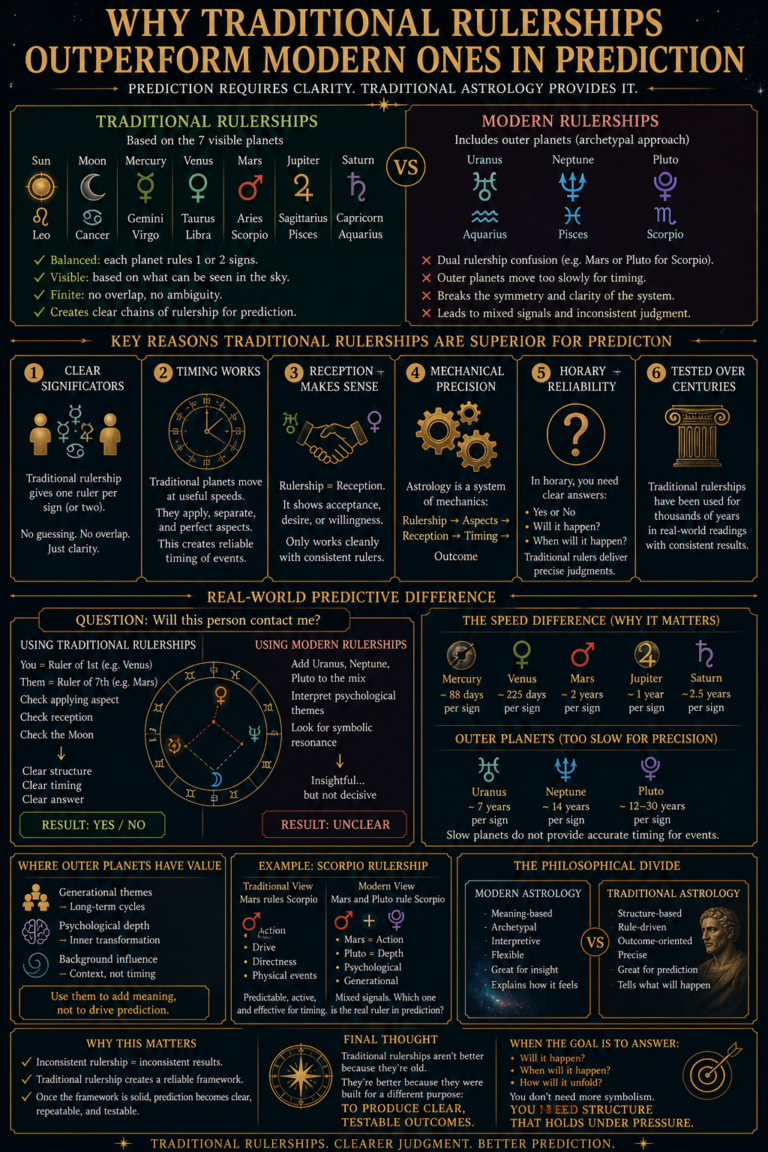
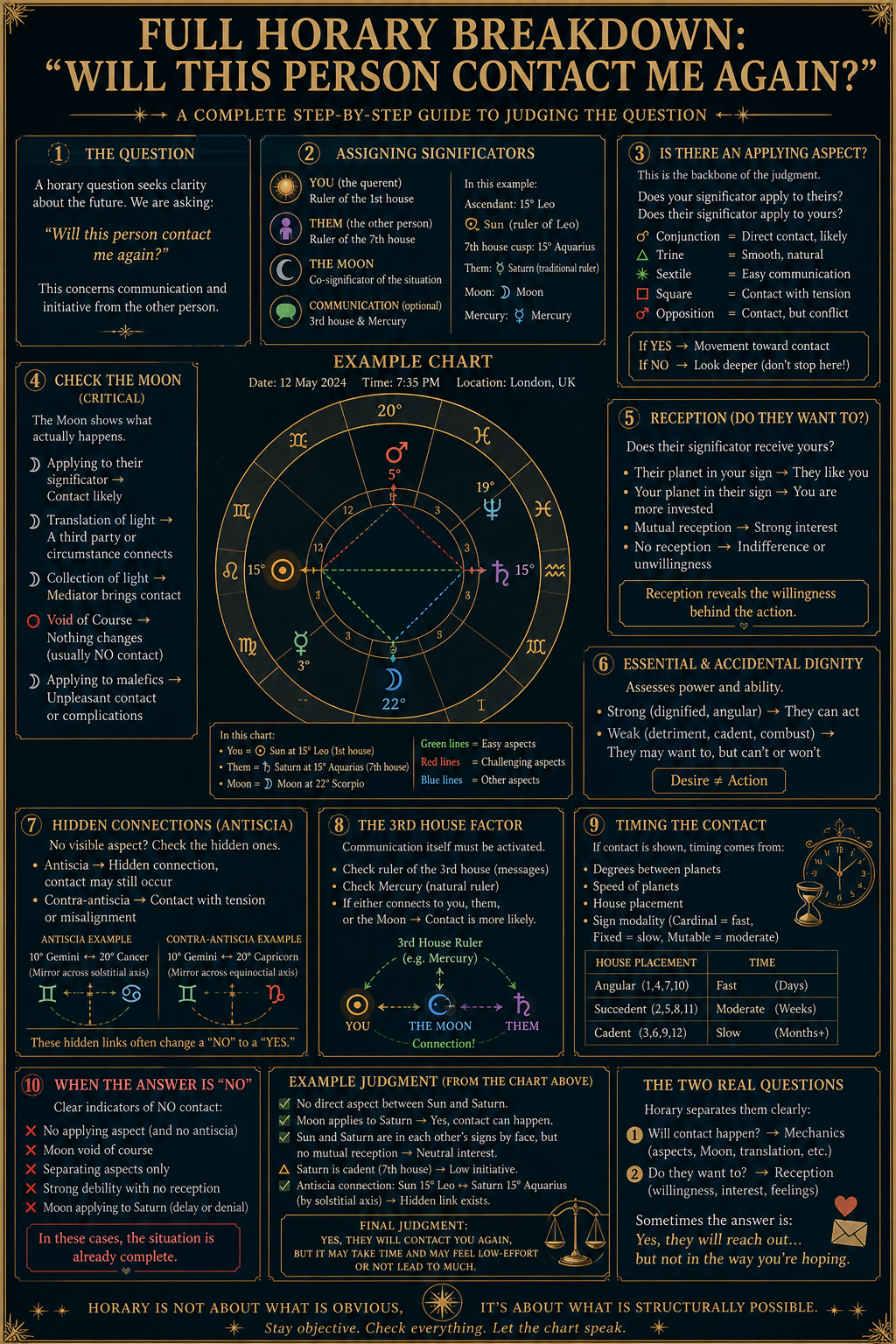
Step 1: Assigning Significators
Everything begins with clear rulership.
- You (the querent) → Ruler of the 1st house
- Them (the other person) → Ruler of the 7th house
- The Moon → Co-significator of the situation (flow of events)
If communication itself is emphasized, you may also check:
- 3rd house (messages, texts, calls)
Step 2: Is There an Applying Aspect?
This is the backbone of the judgment.
Ask:
→ Does your significator apply to theirs?
→ Does their significator apply to yours?
If YES:
- There is movement toward contact
- The type of aspect matters:
- Trine/Sextile → Smooth, natural communication
- Conjunction → Direct contact, often inevitable
- Square → Contact with tension or difficulty
- Opposition → Contact, but often with conflict or closure
If NO:
- Look deeper (this is where most people stop too early)
Step 3: Check the Moon (Critical)
The Moon shows what actually happens.
Look for:
- Applying aspect to their significator → Contact likely
- Translation of light → A third party or circumstance connects you
- Collection of light → A mediator or shared situation brings contact
If the Moon is:
- Void of Course → Nothing changes (usually no contact)
- Applying to malefics → Contact may happen but be unpleasant
Step 4: Reception (Do They Even Want To?)
This is where emotional reality comes in.
Ask:
→ Does their significator receive yours?
Examples:
- Their planet in your sign → They are interested in you
- Your planet in their sign → You are more invested
Strong Mutual Reception:
→ Contact is much more likely (even if delayed)
No Reception:
→ Even if contact happens, it may feel:
- Cold
- Forced
- Superficial
Reception answers the question:
→ “Do they want to reach out?”
Step 5: Essential & Accidental Dignity
Now assess power and ability.
If their significator is:
- Strong (dignified, angular) → They have the ability to act
- Weak (detriment, cadent, combust) → They may want to, but can’t or won’t
This is key:
→ Desire ≠ Action
Someone can like you and still not reach out.
Step 6: Hidden Connections (Antiscia)
This is where advanced judgment comes in.
Even if there’s no visible aspect:
→ Do the significators meet by antiscia?
If yes:
- There is a hidden connection
- Contact may still occur—often quietly or unexpectedly
If by contra-antiscia:
- Contact may happen, but with tension or misalignment
This is one of the biggest reasons beginners misjudge charts.
Step 7: The 3rd House Factor
If you want precision, check communication itself.
- Ruler of the 3rd (from them = turned 3rd, i.e., 9th house)
- Mercury (natural ruler of communication)
If these connect to:
- Your significator
- The Moon
→ Strong indication of messaging/contact
Step 8: Timing the Contact
If contact is shown, timing comes from:
- Degrees between planets
- Speed of planets
- House placement
General guide:
- Angular → Fast (days)
- Succedent → Moderate (weeks)
- Cadent → Slow (months or more)
Also consider:
- Sign modality (Cardinal = fast, Fixed = slow, Mutable = moderate)
Step 9: When the Answer Is “No”
Clear “no contact” indicators:
- No applying aspect (and no antiscia)
- Moon void of course
- Separating aspects only
- Strong debility with no reception
- Moon applying to Saturn (delay or denial)
In these cases:
→ The situation is already complete
Real Example Interpretation Flow
A typical judgment might look like:
- No direct aspect between significators ❌
- Moon applies to their ruler ✅
- Weak reception (they’re neutral)
- Their planet is cadent (low initiative)
- Antiscia connection present
Final Judgment:
→ Yes, they will contact—but:
- It may take time
- It may feel casual or low-effort
- It may not lead to anything substantial
The Biggest Mistake People Make
They stop at Step 2.
They see:
→ “No aspect = no contact”
And miss:
- The Moon
- Reception
- Antiscia
- Indirect perfection
Horary is not just about what is obvious.
It’s about:
→ What is structurally possible
Final Thought
When asking “Will they contact me again?”
you’re really asking two different things:
- Will contact happen? (mechanics)
- Do they want to? (reception)
Horary separates these cleanly.
And sometimes the answer is:
→ Yes, they will reach out…
→ But not in the way you’re hoping
That distinction is where horary becomes not just predictive—
…but honest.