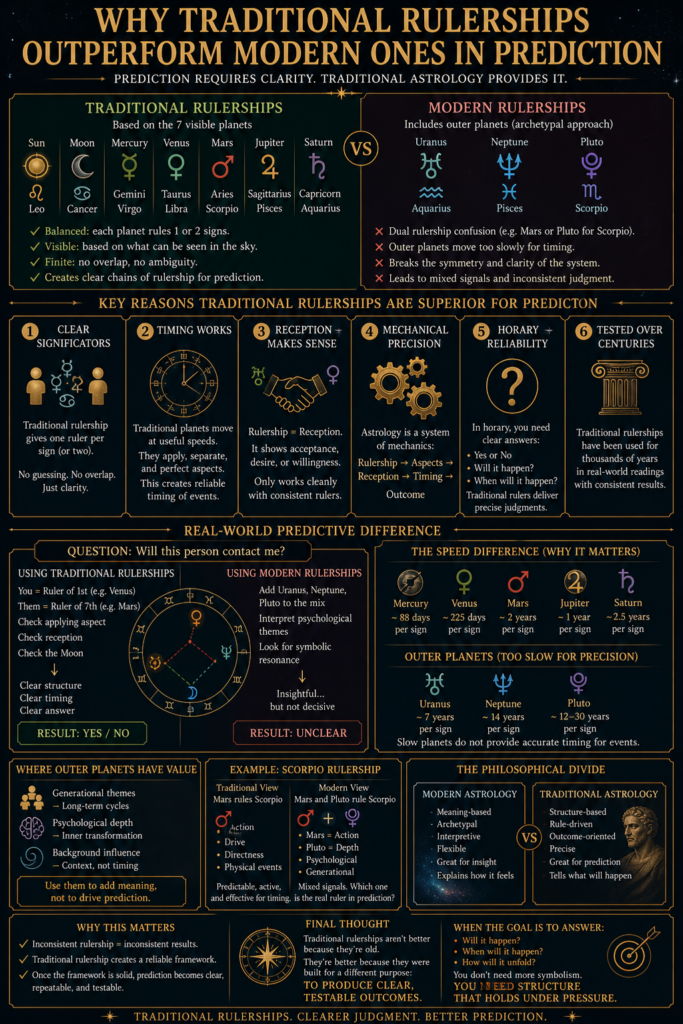
The Core Difference
At some point, every serious astrologer runs into this question:
Should I use traditional rulers… or modern ones?
- Traditional rulerships assign planets based on visible symmetry and classical structure
- Modern rulerships introduce outer planets based on thematic similarity
Both can describe personality.
But when it comes to prediction—timing events, judging outcomes, making clear yes/no calls—traditional rulerships consistently outperform.
Not because they’re “older”…
…but because they are structurally precise.
The Traditional System (Why It’s Built for Accuracy)
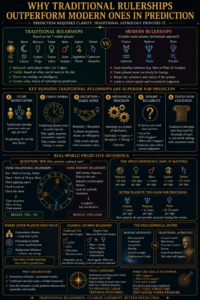
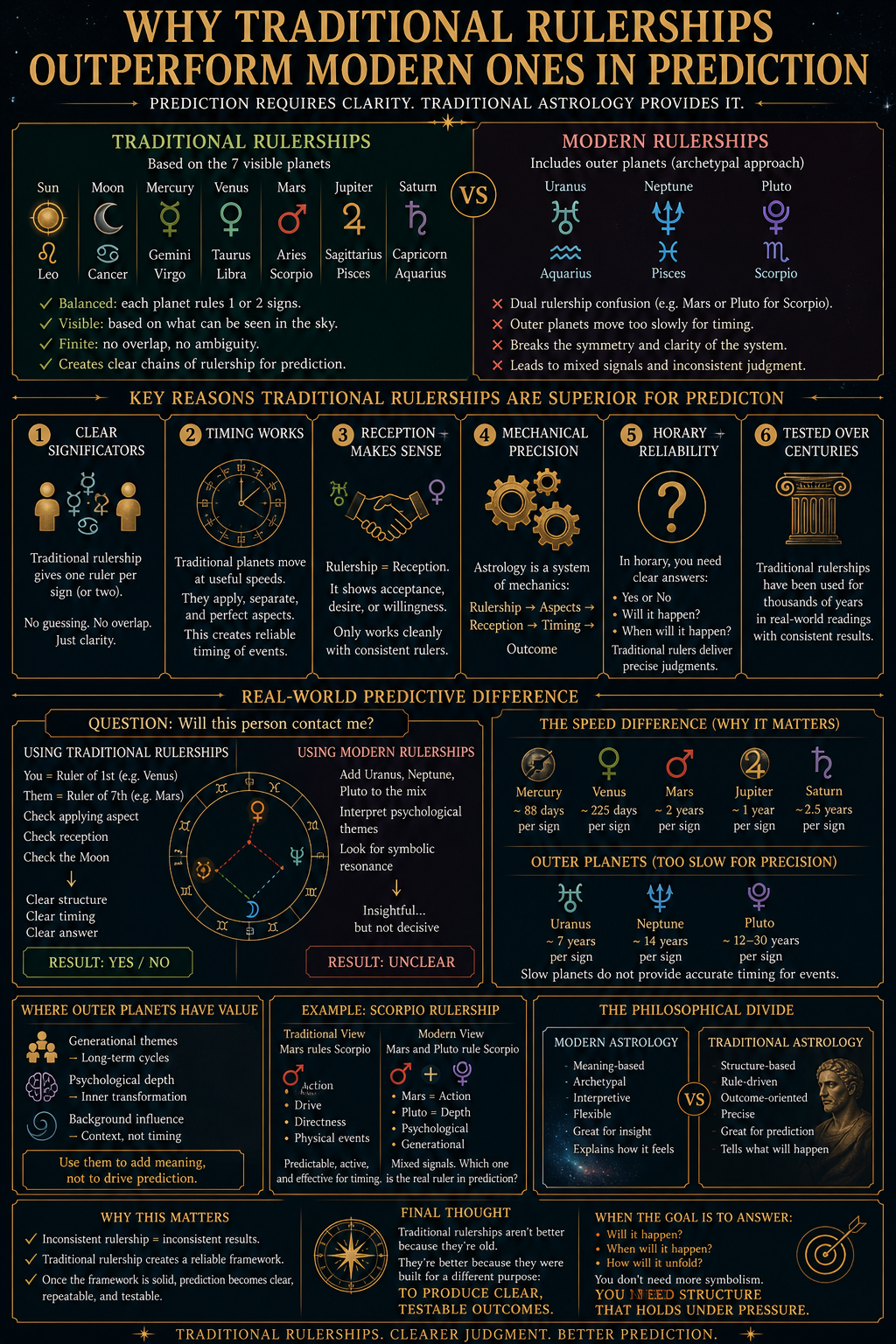
Traditional rulership follows a closed, symmetrical system based on the seven visible planets:
- Sun → Leo
- Moon → Cancer
- Mercury → Gemini, Virgo
- Venus → Taurus, Libra
- Mars → Aries, Scorpio
- Jupiter → Sagittarius, Pisces
- Saturn → Capricorn, Aquarius
This system:
- Is balanced (each planet rules one or two signs)
- Is visible (based on what can be seen in the sky)
- Is finite (no overlap, no ambiguity)
That last point matters most.
Prediction requires clear rulership chains.
Traditional astrology gives you exactly that.
The Problem With Modern Rulerships
Modern astrology assigns:
- Uranus → Aquarius
- Neptune → Pisces
- Pluto → Scorpio
These assignments are based on archetypal similarity, not structural necessity.
That creates problems:
1. Dual Rulership Confusion
Is Scorpio ruled by Mars or Pluto?
- Mars → direct, physical, decisive
- Pluto → psychological, slow, generational
When predicting, this ambiguity leads to:
→ Mixed signals
→ Contradictory interpretations
2. Timing Breaks Down
Outer planets move extremely slowly:
- Uranus: ~7 years per sign
- Neptune: ~14 years per sign
- Pluto: ~12–30 years per sign
In horary or predictive work:
→ They barely move
→ They don’t apply or separate in useful ways
→ They fail to indicate timing of events
Compare that to Mercury or Venus:
→ Fast, responsive, precise
Prediction needs motion.
Outer planets don’t deliver it.
3. Loss of Mechanical Clarity
Traditional astrology works like a system of gears:
- Rulership → determines significator
- Aspects → determine interaction
- Reception → determines willingness
- Motion → determines timing
If rulership is unclear, the entire system weakens.
Modern rulerships introduce:
→ Interpretive flexibility
→ But at the cost of mechanical reliability
Why Traditional Rulership Wins in Horary
Horary astrology is the ultimate test.
You’re answering:
- Yes or no
- Will it happen or not
- When will it happen
There’s no room for vagueness.
Using traditional rulers:
- You get clear significators
- You can track applying aspects
- You can judge perfection of the matter
Using modern rulers:
- Significators become inconsistent
- Timing becomes unclear
- Judgments become interpretive instead of decisive
This is why nearly all serious horary practitioners default to traditional rulership.
Reception: The Hidden Advantage
Reception is one of the most powerful tools in prediction.
Example:
- Mars in Venus’s sign → Mars “receives” Venus
This tells you:
→ One party accepts or desires the other
But reception only works cleanly when:
- Rulership is consistent and exclusive
Traditional rulership maintains this.
Modern rulership muddies it:
→ Does Pluto receive Mars?
→ Does Neptune receive Jupiter?
The logic becomes unclear—and so does the judgment.
Real-World Predictive Difference
Let’s say you’re judging:
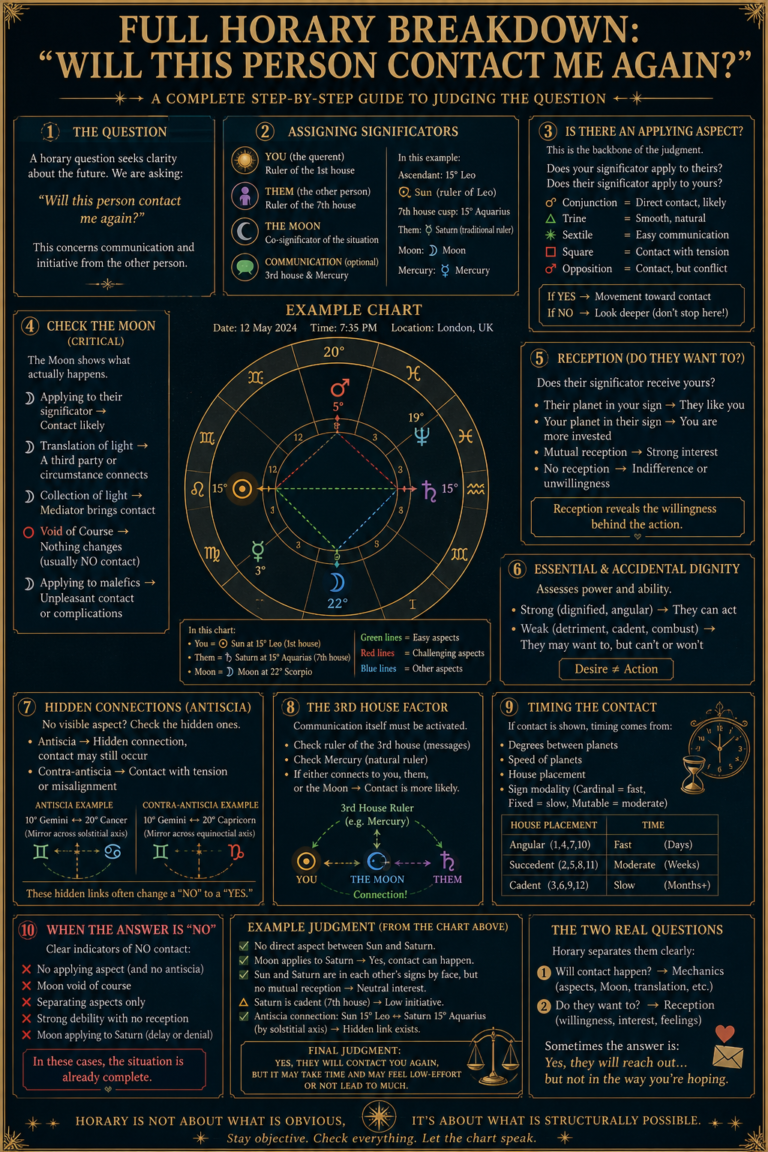
“Will this person contact me?”
Traditional method:
- You = ruler of 1st
- Them = ruler of 7th
- Check aspect, reception, Moon
→ Clear structure
→ Clear answer
Modern method:
- Add Uranus, Neptune, Pluto
- Interpret psychological themes
- Look for symbolic resonance
→ Insightful… but not decisive
One tells you what will happen
The other tells you how it feels
Where Modern Planets Still Have Value
This isn’t about rejection—it’s about placement of use.
Outer planets are excellent for:
- Generational themes
- Psychological depth
- Background influences
But they are:
→ Supporting actors, not rulers of the system
Use them to add meaning, not to drive prediction
The Philosophical Divide
This comes down to two different approaches:
Modern Astrology:
- Meaning-based
- Archetypal
- Interpretive
Traditional Astrology:
- Structure-based
- Rule-driven
- Outcome-oriented
If your goal is:
→ Self-understanding → modern works well
→ Accurate prediction → traditional dominates
Why This Matters More Than People Think
Most people struggle with prediction not because:
- Astrology doesn’t work
…but because:
- Their framework is inconsistent
Once you switch to traditional rulership:
- Charts become cleaner
- Judgments become faster
- Outcomes become more reliable
It feels less like guessing…
…and more like reading a system.
Final Thought
Traditional rulership isn’t “better” because it’s old.
It’s better because it was built for a different purpose:
→ To produce clear, testable outcomes
In prediction, clarity beats creativity.
And when the goal is to answer:
- Will it happen?
- When will it happen?
- How will it unfold?
You don’t need more symbolism.
You need structure that holds under pressure.