The Illusion of Objectivity
Astrology feels objective.
You’re looking at a chart, applying rules, reading symbols—it seems structured, almost mathematical. But in reality, chart judgment sits right at the intersection of pattern recognition and human perception.
And human perception is not neutral.
Most misjudgments in astrology don’t come from lack of knowledge. They come from cognitive bias—the invisible filters shaping how we interpret what we see.
What Is Cognitive Bias?
Cognitive biases are mental shortcuts your brain uses to make quick decisions. They’re efficient—but not always accurate.
In astrology, they show up as:
- Seeing what you expect to see
- Ignoring what doesn’t fit your narrative
- Overvaluing certain symbols based on personal experience
In other words, the chart isn’t wrong—the lens is.
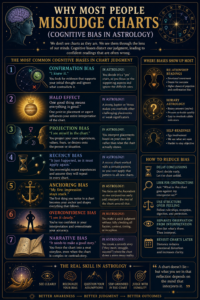
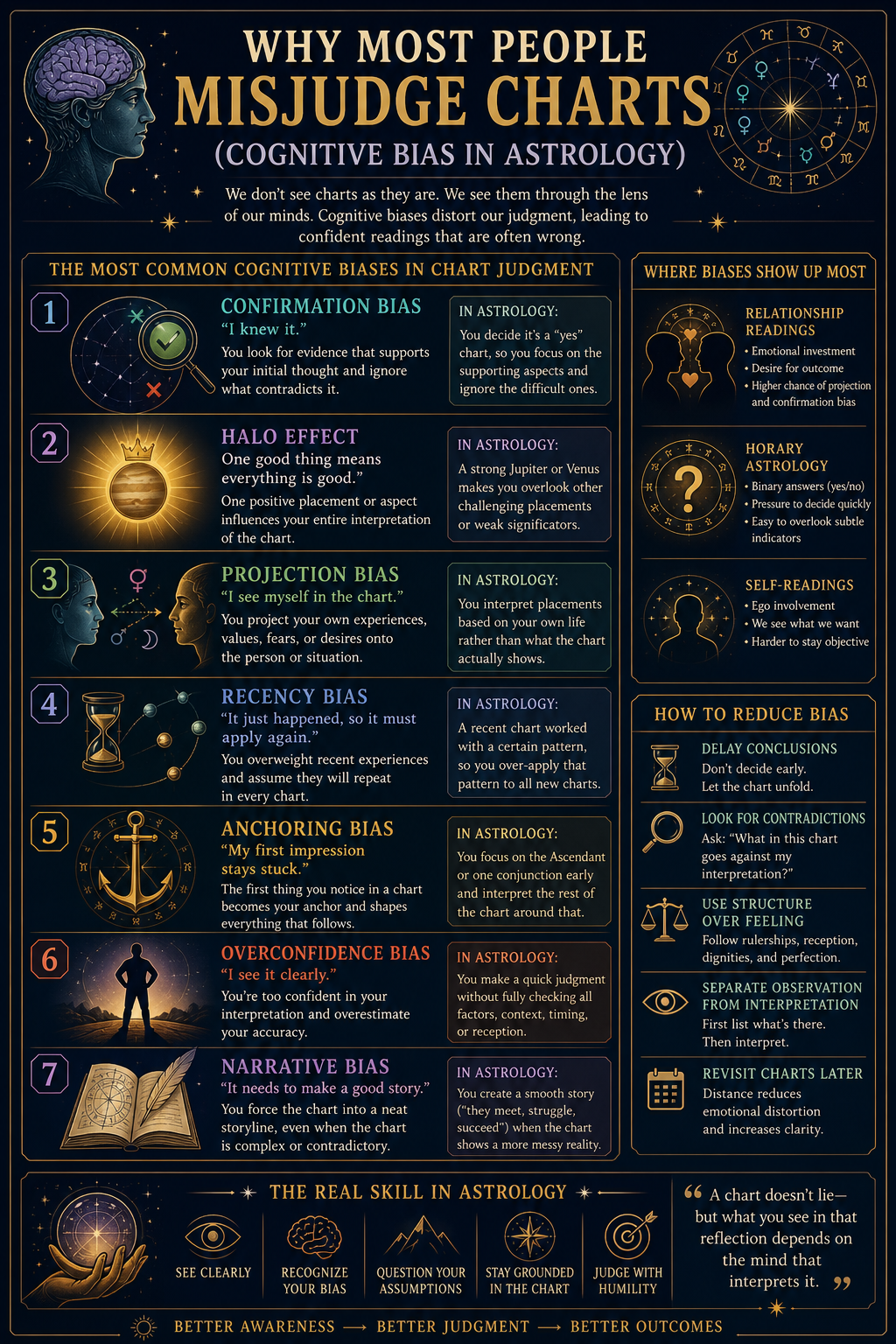
1. Confirmation Bias: “I Knew It”
This is the most common trap.
You form a hypothesis early:
- “This looks like a strong relationship chart”
- “This person seems successful”
- “This horary looks like a yes”
And then your brain starts selecting evidence to support that idea.
You’ll emphasize:
- Favorable aspects
- Strong placements
- Positive receptions
And subconsciously minimize:
- Contradictions
- Debilities
- Timing issues
The result?
→ A reading that feels coherent… but is selectively constructed
2. Halo Effect: One Placement Dominates Everything
Someone has:
- Venus in Libra
- Sun in Leo
- Jupiter on the Midheaven
And suddenly the entire chart gets interpreted through a positive glow.
The opposite also happens:
- Saturn in the 7th
- Mars in detriment
Now everything feels difficult—even if there are strong mitigating factors.
This is the halo effect:
→ One standout feature distorts the whole chart
In reality, charts are systems—not highlight reels.
3. Projection Bias: Reading Yourself Into the Chart
This one is subtle—and dangerous.
You interpret a chart based on:
- Your own personality
- Your past relationships
- Your current emotional state
Example:
- You value independence → you interpret Aquarius placements as “healthy detachment”
- Someone else fears distance → they interpret the same placement as “emotional unavailability”
Same chart. Different reader. Completely different story.
4. Recency Bias: Overweighting What Just Happened
If you recently saw:
- A breakup tied to Mars-Saturn
- A promotion tied to Jupiter transit
You’re more likely to over-apply that pattern to new charts.
Your brain says:
“This worked last time—use it again.”
But astrology isn’t a fixed template. Context matters:
- House rulership
- Reception
- Timing
- The actual question being asked
Recency bias turns astrology into pattern mimicry instead of judgment.
5. Anchoring Bias: First Impressions Stick
The first thing you notice in a chart often becomes your anchor.
Maybe it’s:
- The rising sign
- A conjunction
- A retrograde planet
Everything else gets interpreted relative to that first impression—even if it’s not the most important factor.
In horary especially, this can be fatal:
→ You lock onto an early “yes” or “no” and struggle to revise it, even as contradictory evidence appears.
6. Overconfidence Bias: “I See It Clearly”
The more experienced you become, the more dangerous this bias gets.
You start to feel:
- Certain in your interpretations
- Fast in your judgments
- Confident in your pattern recognition
But confidence ≠ accuracy.
Astrology punishes overconfidence because:
- Charts are layered
- Context shifts meaning
- Small details change outcomes
The best astrologers aren’t the most certain—they’re the most precise under uncertainty.
7. Narrative Bias: Forcing a Story
Humans love stories.
So instead of reading a chart as a system, we turn it into a clean narrative:
- “They meet, fall in love, face challenges, and grow”
- “This person struggles early, then succeeds later”
But real charts are messy:
- Contradictory signals
- Mixed receptions
- Partial outcomes
Narrative bias smooths over complexity and creates false clarity.
Where This Shows Up Most
Cognitive bias is strongest in:
1. Relationship Readings
- Emotional investment → higher projection
- Desire for outcome → confirmation bias
2. Horary Astrology
- Binary answers → pressure to decide quickly
- Subtle indicators → easy to overlook
3. Self-Readings
- Ego involvement → distorted interpretation
- Difficulty staying neutral
How to Reduce Bias (Without Losing Intuition)
You don’t eliminate bias—you manage it.
Here’s how:
1. Delay Conclusions
Don’t decide early. Let the chart unfold.
2. Actively Look for Contradictions
Ask:
- “What in this chart goes against my interpretation?”
3. Use Structure Over Feeling
Especially in horary:
- Follow rulerships
- Check reception
- Verify perfection
4. Separate Observation from Interpretation
First list what’s there. Then interpret.
5. Revisit Charts Later
Distance reduces emotional distortion.
The Real Skill in Astrology
The hardest part of astrology isn’t learning techniques.
It’s learning to see clearly.
To:
- Recognize your own bias
- Question your assumptions
- Stay grounded in the structure of the chart
Because most wrong readings don’t come from bad astrology…
They come from good astrology filtered through human bias.
Final Thought
A chart doesn’t lie—but it also doesn’t speak loudly.
It reflects.
And what you see in that reflection depends on:
- Your discipline
- Your awareness
- Your ability to step outside your own ذهن
Mastering astrology isn’t just about understanding the sky—
It’s about understanding the mind that interprets it.