

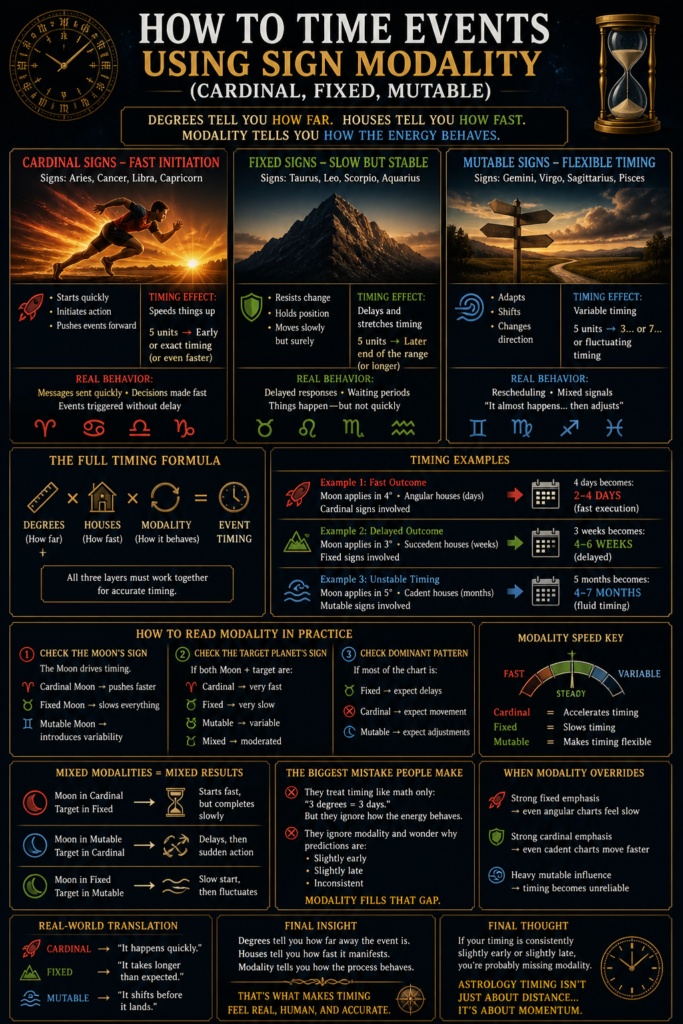
Why Modality Is the Missing Timing Layer
Most astrologers stop at:
- Degrees (how far)
- Houses (how fast)
But there’s a third layer that quietly refines everything:
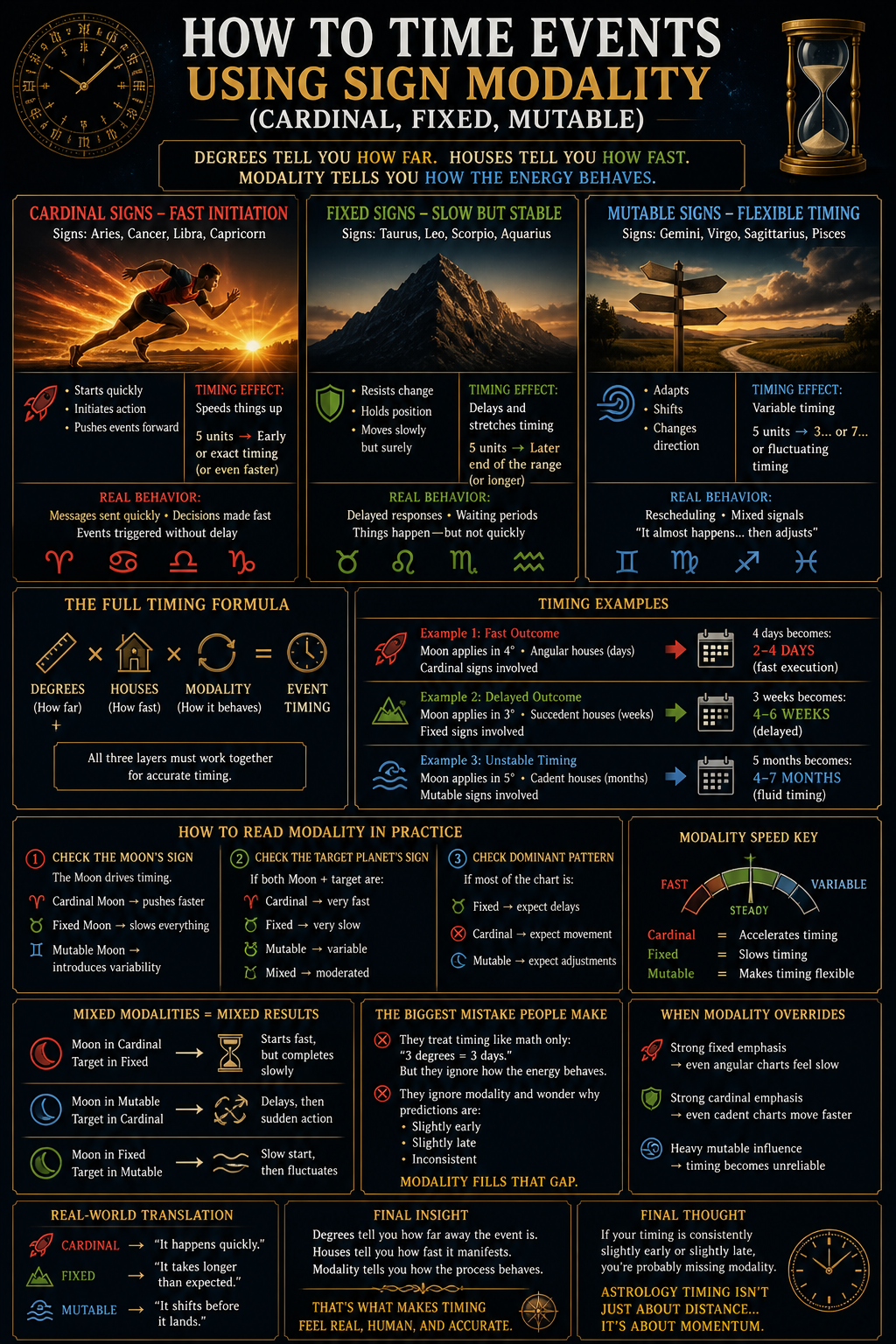
Sign modality = behavioral speed
Even with perfect Moon timing and house placement, results will feel “off” unless you account for whether the energy is:
- Initiating
- Sustaining
- Adapting
That’s what modality controls.
The Three Modalities (Core Behavior Patterns)
Cardinal Signs — Fast Initiation


Signs: Aries, Cancer, Libra, Capricorn
Cardinal energy:
- Starts quickly
- Initiates action
- Pushes events forward
Timing Effect:
→ Speeds things up
If your timing shows:
- 5 units (days/weeks/etc.)
Cardinal signs often bring it to:
→ Early or exact timing (or even faster)
Real Behavior:
- Messages sent quickly
- Decisions made fast
- Events triggered without delay
Fixed Signs — Slow but Stable


Signs: Taurus, Leo, Scorpio, Aquarius
Fixed energy:
- Resists change
- Holds position
- Moves slowly but surely
Timing Effect:
→ Delays and stretches timing
If you see:
- 5 units
Fixed signs often shift it to:
→ Later end of the range (or longer)
Real Behavior:
- Delayed responses
- Waiting periods
- Things happen—but not quickly
Mutable Signs — Flexible Timing


Signs: Gemini, Virgo, Sagittarius, Pisces
Mutable energy:
- Adapts
- Shifts
- Changes direction
Timing Effect:
→ Variable timing
If you see:
- 5 units
Mutable signs can produce:
→ 3… or 7… or fluctuating timing
Real Behavior:
- Rescheduling
- Mixed signals
- “It almost happens… then adjusts”
The Full Timing Formula (Now Complete)
Timing =
Degrees × House Speed × Modality Adjustment
Example 1: Fast Outcome
- Moon applies in 4 degrees
- Angular houses → days
- Cardinal signs involved
→ 4 days becomes:
✅ 2–4 days (fast execution)
Example 2: Delayed Outcome
- Moon applies in 3 degrees
- Succedent houses → weeks
- Fixed signs
→ 3 weeks becomes:
⏳ 4–6 weeks (delayed)
Example 3: Unstable Timing
- Moon applies in 5 degrees
- Cadent houses → months
- Mutable signs
→ 5 months becomes:
🔄 4–7 months (fluid timing)
How to Read Modality in Practice
Step 1: Check the Moon’s Sign
The Moon drives timing.
- Cardinal Moon → pushes faster
- Fixed Moon → slows everything
- Mutable Moon → introduces variability
Step 2: Check the Target Planet’s Sign
If both Moon + target are:
- Cardinal → very fast
- Fixed → very slow
- Mixed → moderated
Step 3: Check Dominant Pattern
If most of the chart is:
- Fixed → expect delays
- Cardinal → expect movement
- Mutable → expect adjustments
Advanced Layer: Mixed Modalities
Most charts are not pure.
Example:
- Moon in Cardinal
- Target planet in Fixed
Result:
→ Starts fast, but completes slowly
Or:
- Moon Mutable
- Target Cardinal
→ Delays, then sudden action
This is where timing becomes:
→ dynamic, not static
The Biggest Mistake People Make
They treat timing like math only:
- “3 degrees = 3 days”
But ignore:
→ how the energy behaves
That’s why predictions feel:
- Slightly off
- Too early
- Too late
Modality fixes that gap.
Real-World Translation
- Cardinal → “It happens quickly”
- Fixed → “It takes longer than expected”
- Mutable → “It shifts before it lands”
When Modality Overrides Everything
Sometimes modality dominates:
- Strong fixed emphasis → even angular charts feel slow
- Strong cardinal emphasis → even cadent charts move faster
- Heavy mutable influence → timing becomes unreliable
Final Insight
Degrees tell you:
→ How far away the event is
Houses tell you:
→ How fast it manifests
Modality tells you:
→ How the process behaves
And that last piece is what makes timing feel:
- Real
- Human
- Accurate
Final Thought
If your timing is consistently:
- Slightly early
- Slightly late
You’re probably missing modality.
Because astrology timing isn’t just about distance…
It’s about momentum.