
The Hidden Hierarchy Most People Miss
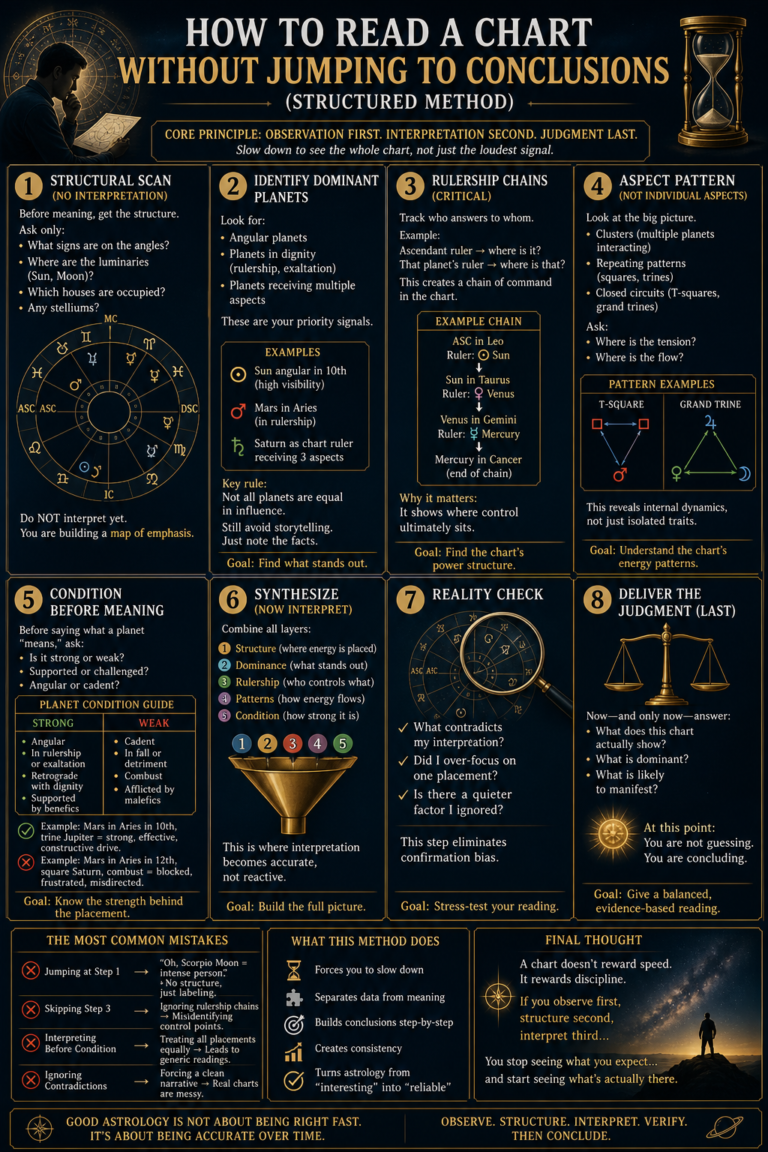
A natal chart isn’t a flat list of placements.
It’s a chain of command.
Every planet answers to another planet based on sign rulership. When you follow those chains far enough, you uncover something far more important than any single placement:
Who actually controls the chart.
That’s what a dispositor tree reveals.
What Is a Dispositor?
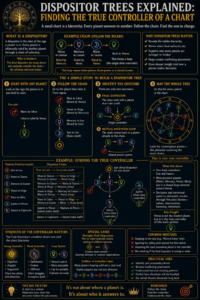
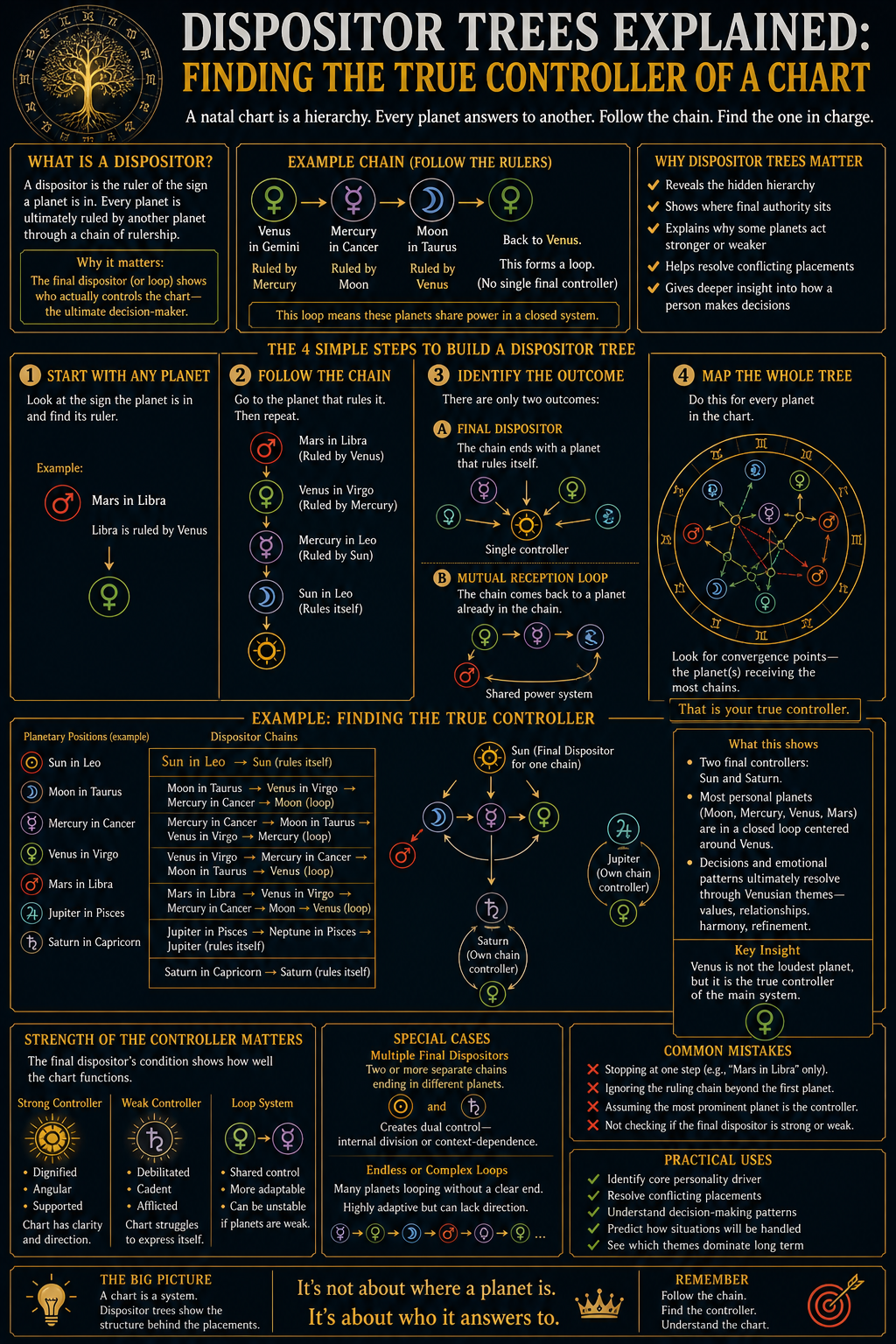
A dispositor is the ruler of the sign a planet is in.
Example:
- Venus in Gemini → ruled by Mercury
- Mercury in Cancer → ruled by Moon
- Moon in Taurus → ruled by Venus
You’ve now formed a loop:
→ Venus → Mercury → Moon → Venus
That loop is not random.
It’s a closed power circuit.
Why Dispositor Trees Matter
Most readings focus on:
- Aspects
- Houses
- Signs
But without dispositors, you miss:
→ where the final authority sits
Two charts can have identical placements…
…but completely different power structures depending on dispositors.
Step 1: Start With the Basics


Pick any planet and ask:
→ “What sign is it in?”
→ “Who rules that sign?”
Then repeat.
Example chain:
- Mars in Libra → ruled by Venus
- Venus in Virgo → ruled by Mercury
- Mercury in Leo → ruled by Sun
Now stop.
You’ve reached a planet that:
→ Rules itself (Sun in Leo)
That’s an endpoint.
Step 2: Identify Endpoints
There are only two possible outcomes:
1. Final Dispositor (Single Controller)


If all chains lead to one planet:
→ That planet is the final dispositor
It acts as:
- The central authority
- The ultimate decision-maker
- The “boss” of the chart
This is rare—but extremely powerful.
2. Mutual Reception Loop (Closed System)


If planets lead back to each other:
→ You get a closed loop
Example:
- Mars → Venus → Mercury → Moon → Venus
No single controller.
Instead:
→ Shared power system
These charts feel:
- More dynamic
- Less centralized
- More context-dependent
Step 3: Map the Whole Tree
Now do this for every planet.
You’ll start to see:
- Multiple chains
- Convergence points
- Dominant endpoints
What you’re building is:
→ A network map of influence
Step 4: Find the Controller(s)
Ask:
- Which planet receives the most chains?
- Which planet is the endpoint for multiple paths?
- Which planet sits in a loop with strong planets?
That’s your:
→ true controller
Not the loudest planet.
The one everything feeds into.
Real Example (Conceptual)
Let’s say:
- Sun → Mercury → Moon → Venus
- Mars → Venus
- Jupiter → Mercury → Moon → Venus
- Saturn → Venus
Everything leads to:
→ Venus
Even if Venus isn’t angular…
Even if Venus isn’t the most obvious…
It becomes:
→ The final dispositor
Meaning:
- The chart ultimately operates through Venusian themes
- Decisions resolve through Venus logic (relationships, values, harmony)
Why This Changes Everything
Without dispositors, you might say:
- “Mars is strong”
- “Sun is dominant”
But with dispositors:
→ You see where those planets report to
A strong Mars ruled by a weak Venus:
→ Mars becomes compromised
A weak planet ruled by a strong final dispositor:
→ It gains support
The Dispositor vs The Obvious Planet
This is the key distinction:
- Obvious planet → what stands out
- Dispositor → what actually controls
Beginners read:
→ What’s loud
Advanced readers track:
→ What’s in charge
Advanced Layer: Dispositor Strength
Not all dispositors are equal.
Once you find the controller, ask:
- Is it dignified or debilitated?
- Angular or cadent?
- Supported or afflicted?
This tells you:
→ Whether the system is stable or flawed
Special Cases
Multiple Final Dispositors
Sometimes you’ll get:
- Two separate chains ending in different planets
This creates:
→ Dual control system
These people often feel:
- Internally divided
- Context-dependent
No Clear Endpoint (Endless Chains)
Rare, but possible in complex loops.
This creates:
→ Highly adaptive, but unstable structure
The Biggest Mistake People Make
They stop at:
→ “This planet is strong”
Without asking:
→ “Who controls this planet?”
That’s like analyzing employees without knowing:
→ Who the CEO is
Practical Use
Use dispositors to:
- Identify core personality driver
- Resolve conflicting placements
- Understand decision-making patterns
- Clarify which planet actually “wins”
Final Insight
A chart is not a list.
It’s a system.
And every system has:
- Inputs
- Flows
- Control points
Dispositor trees reveal:
→ The control point
Final Thought
If you want to level up your readings:
Stop asking:
→ “What does this placement mean?”
Start asking:
→ “Where does this placement lead?”
Because in astrology…
What matters most isn’t where a planet is.
It’s:
→ who it answers to.