
The Real Problem: Speed Feels Like Skill
Most misread charts don’t come from lack of knowledge.
They come from reading too fast.
- You spot a strong placement
- You form a narrative
- Everything else gets filtered through that lens
It feels efficient. It’s actually bias in motion.
A structured method slows you down just enough to:
→ See the whole chart
→ Not just the loudest signal
The Core Principle
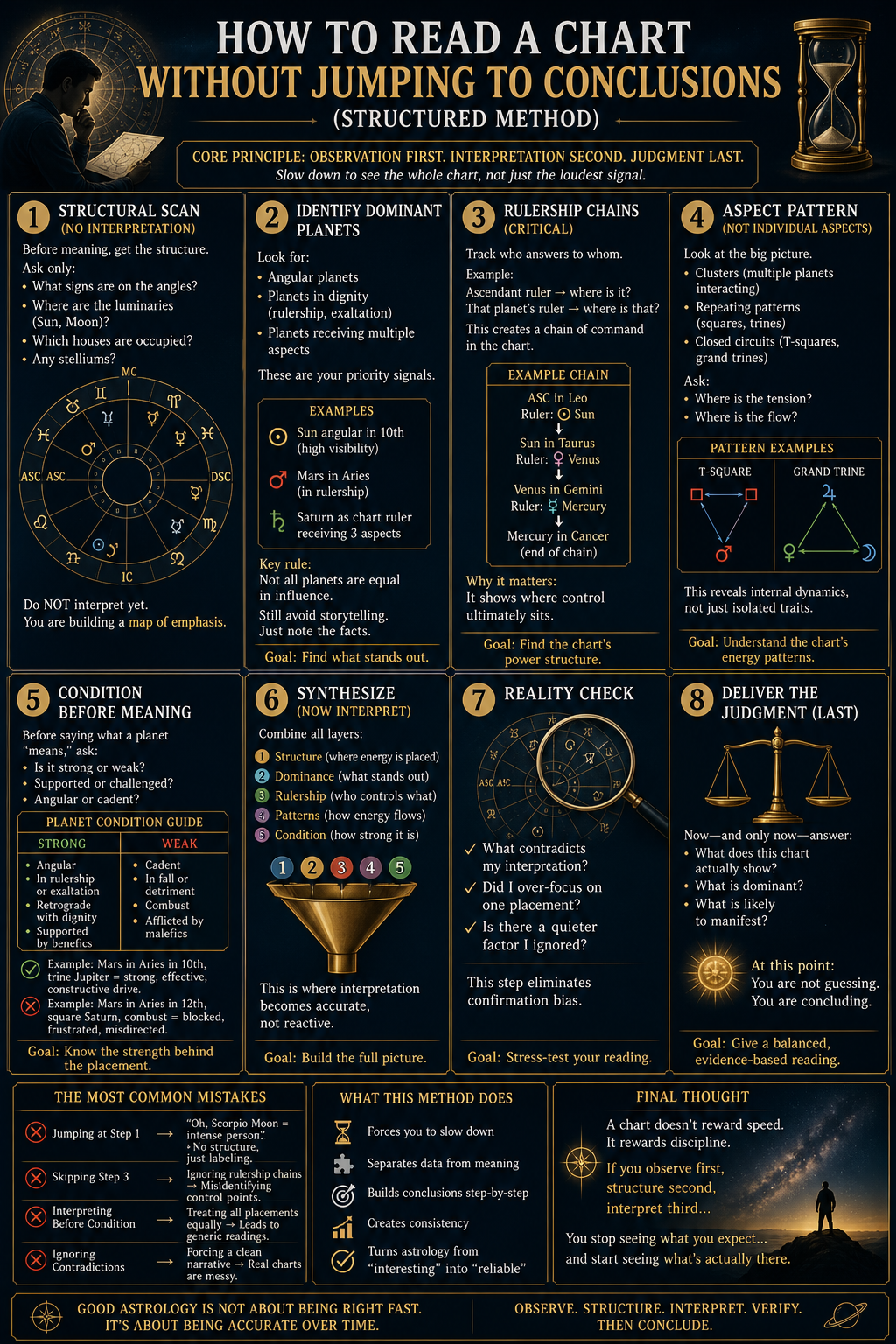
Observation first. Interpretation second. Judgment last.
If you collapse those steps into one, you’ll almost always:
→ Overweight what stands out
→ Miss what actually matters
Step 1: Structural Scan (No Interpretation)


Before meaning, get the structure.
Ask only:
- What signs are on the angles?
- Where are the luminaries (Sun, Moon)?
- Which houses are occupied?
- Any stelliums?
Do NOT interpret yet.
You’re building:
→ A map of emphasis
Step 2: Identify Dominant Planets
Now look for:
- Angular planets
- Planets in dignity (rulership, exaltation)
- Planets receiving multiple aspects
These are your priority signals.
Key rule:
→ Not all planets are equal in influence
At this stage, still avoid storytelling.
Just note:
- “Mars is angular”
- “Saturn is debilitated”
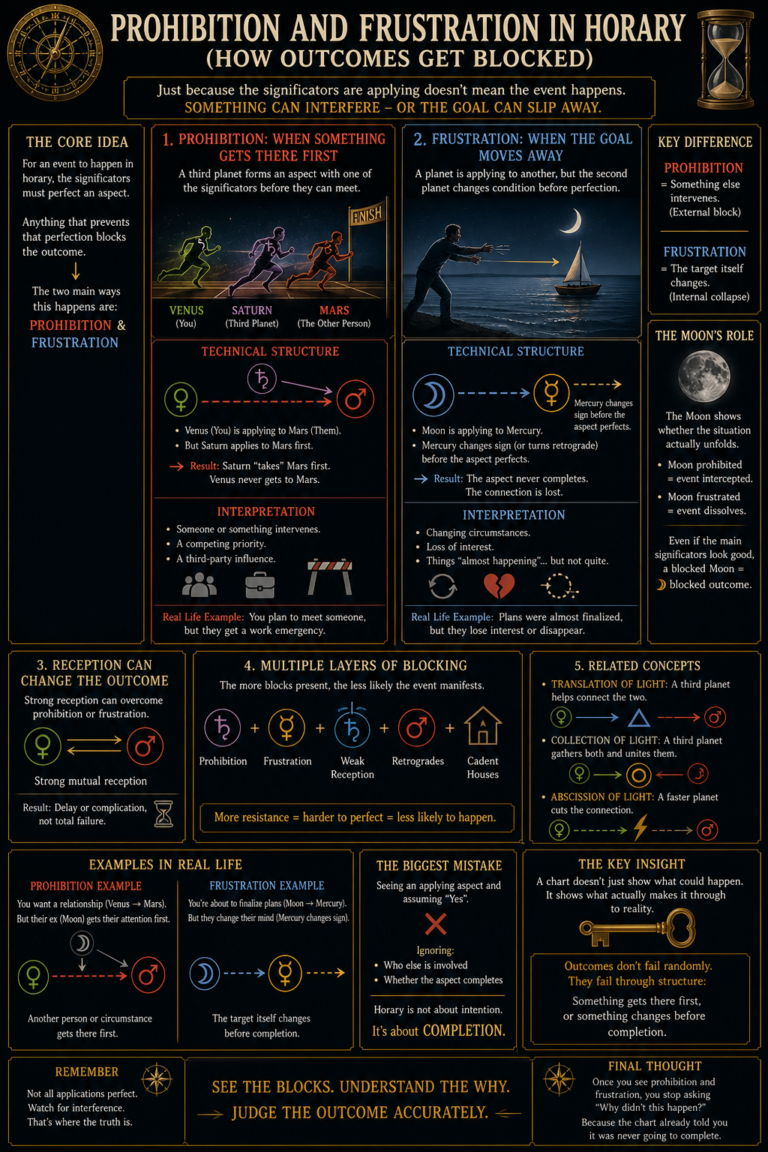
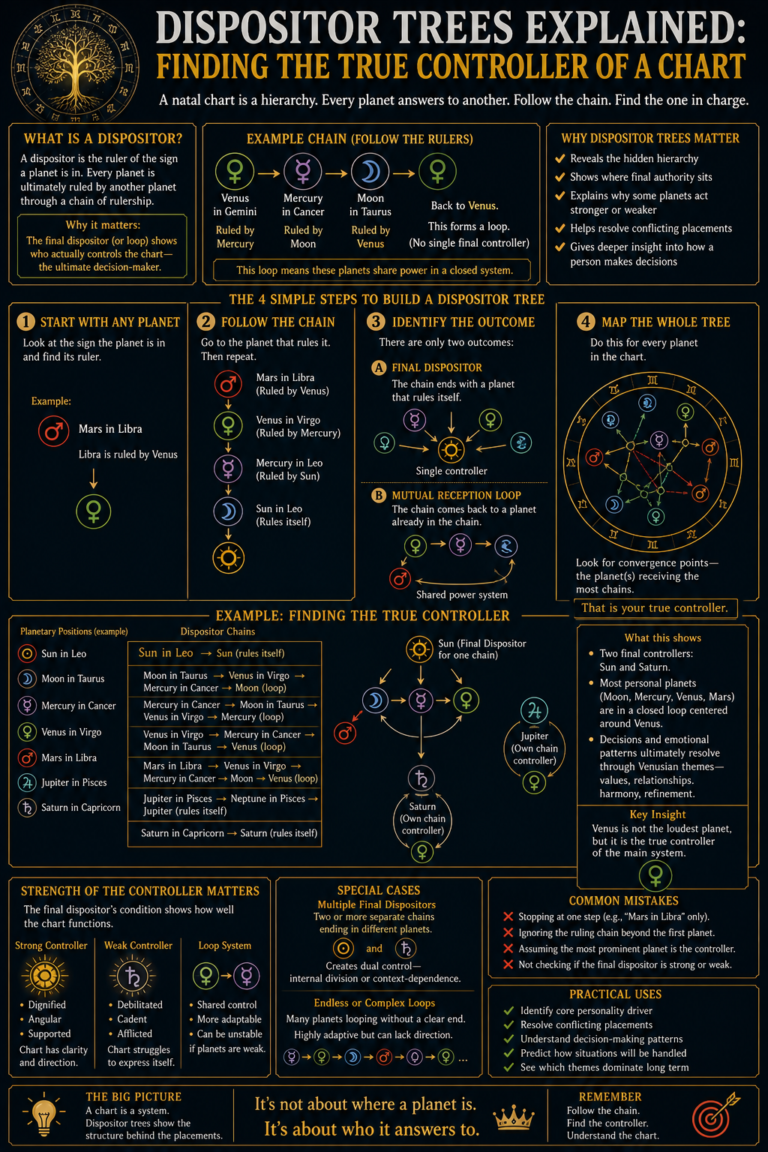
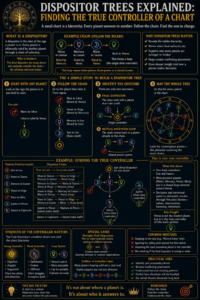
Step 3: Rulership Chains (Critical)


Now track:
→ Who answers to whom
Example:
- Ascendant ruler → where is it?
- That planet’s ruler → where is that?
This creates a chain of command in the chart.
Why it matters:
→ It shows where control ultimately sits
Many people skip this—and misjudge power entirely.
Step 4: Aspect Pattern (Not Individual Aspects)
Don’t isolate aspects.
Look at:
- Clusters (multiple planets interacting)
- Repeating patterns (squares, trines)
- Closed circuits (T-squares, grand trines)
Ask:
→ Where is the tension?
→ Where is the flow?
This reveals:
- Internal dynamics
- Not just isolated traits
Step 5: Condition Before Meaning


Before saying what a planet “means,” ask:
- Is it strong or weak?
- Supported or challenged?
- Angular or cadent?
Same placement, different condition = different outcome.
Example:
- Mars in Aries (strong) → direct, effective
- Mars in Aries but cadent + afflicted → scattered, blocked
Meaning comes after condition.
Step 6: Synthesize (Now You Can Interpret)
Only now do you combine:
- Structure (Step 1)
- Dominance (Step 2)
- Rulership (Step 3)
- Patterns (Step 4)
- Condition (Step 5)
This is where interpretation becomes:
→ Accurate instead of reactive
Step 7: Reality Check


Before final judgment, ask:
- What contradicts my interpretation?
- Did I over-focus on one placement?
- Is there a quieter factor I ignored?
This step eliminates:
→ Confirmation bias
Step 8: Deliver the Judgment (Last, Not First)
Now—and only now—you answer:
- What does this chart actually show?
- What is dominant?
- What is likely to manifest?
At this point:
→ You’re not guessing
→ You’re concluding
The Most Common Mistakes (And Where They Happen)
❌ Jumping at Step 1
- “Oh, Scorpio Moon = intense person”
→ No structure, just labeling
❌ Skipping Step 3
- Ignoring rulership chains
→ Misidentifying control points
❌ Interpreting Before Condition
- Treating all placements equally
→ Leads to generic readings
❌ Ignoring Contradictions
- Forcing a clean narrative
→ Real charts are messy
What This Method Actually Does
It forces you to:
- Slow down
- Separate data from meaning
- Build conclusions step-by-step
Over time, this creates:
→ Consistency
And consistency is what turns astrology from:
- Interesting
Into:
- Reliable
Real Insight
Most people don’t misread charts because they’re unskilled.
They misread them because they:
→ Skip structure and go straight to story
This method reverses that.
Final Thought
A chart doesn’t reward speed.
It rewards discipline.
If you:
- Observe first
- Structure second
- Interpret third
You stop seeing what you expect…
…and start seeing what’s actually there.