
One of the more interesting comparisons in mythology and esoteric studies is between Cronos (Kronos) from Greek mythology and Satan from Christian tradition. While they originate from completely different religious systems, many occult writers, comparative mythologists, and modern spiritual thinkers have noticed symbolic similarities between the two figures.
It is important to note that Cronos and Satan are not the same being in traditional Greek or Christian theology. However, there are enough overlapping themes that the comparison continues to appear in literature, symbolism, and modern occult thought.
Who Was Cronos?
Cronos was the leader of the Titans and father of the Olympian gods. He is best known for:
- Overthrowing his father Uranus
- Becoming ruler of the cosmos
- Swallowing his children to prevent being overthrown
- Eventually being defeated by his son Zeus
Cronos represents a powerful but fearful ruler whose reign ends through rebellion from the next generation.
Who Is Satan?
Satan is commonly depicted as:
- A rebel against divine authority
- A tempter and adversary
- A fallen being cast down from heaven
- A symbol of pride, separation, and opposition to God
Christian theology views Satan as an enemy of divine order rather than a legitimate ruler.
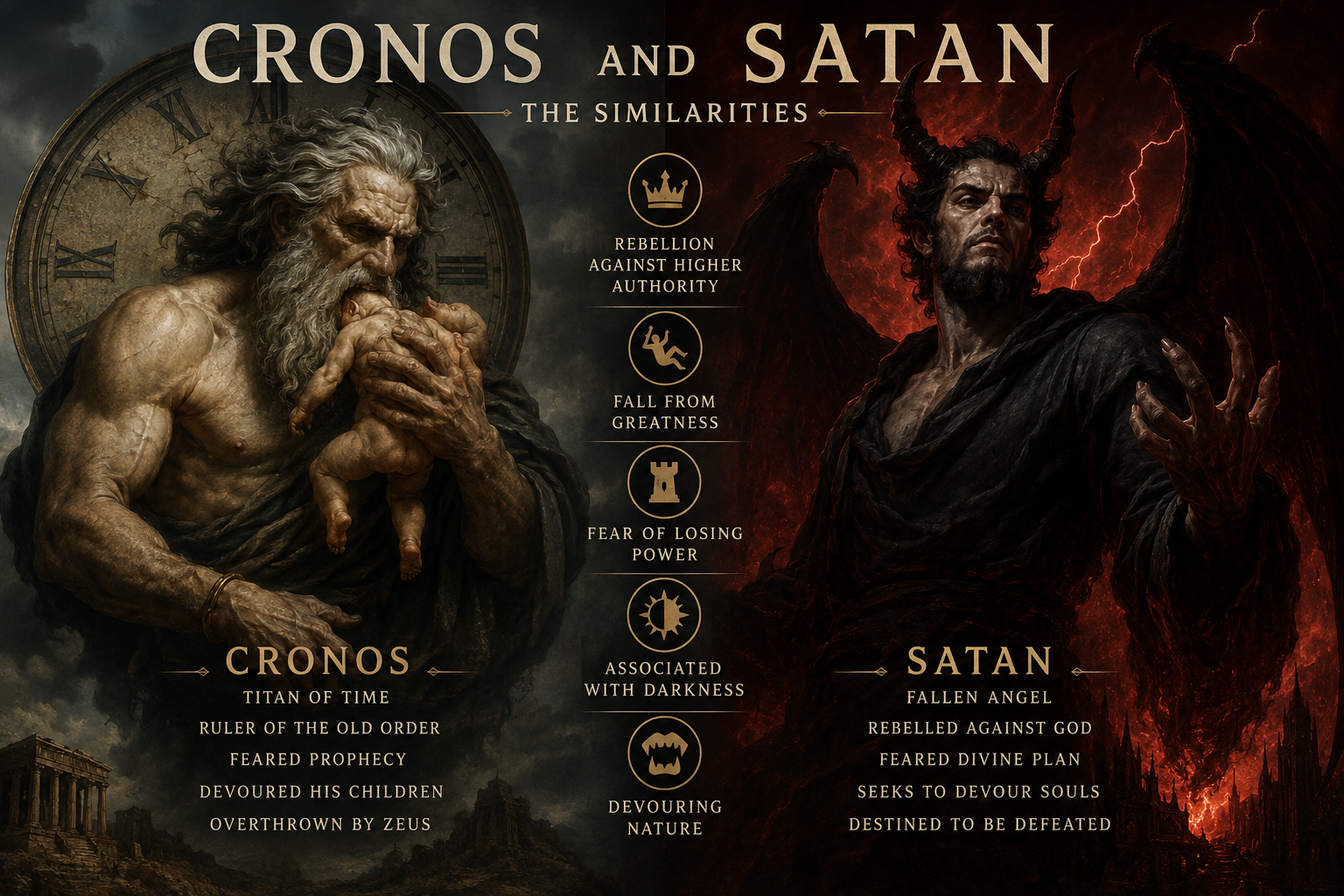
Similarity 1: Both Are Associated with Rebellion
Cronos rebelled against his father Uranus.
Satan is traditionally associated with rebellion against God.
In both stories, a younger power rises against an older cosmic authority. This theme of rebellion against heaven or the established order is one reason the two figures are often compared.
Similarity 2: Both Eventually Fall
Neither figure keeps power permanently.
Cronos loses his kingdom to Zeus.
Satan is cast down and ultimately defeated in Christian prophecy.
Their stories follow a similar pattern:
- Rise to power
- Dominate the cosmos
- Face opposition
- Fall from authority
This “fallen ruler” archetype appears throughout world mythology.
Similarity 3: Fear of Losing Power
One of Cronos’s defining characteristics is fear.
He swallows his children because he knows a prophecy predicts one of them will overthrow him.
Likewise, Satan is often portrayed as desperately resisting God’s plan and attempting to maintain influence over humanity.
In both cases, fear of losing power drives destructive actions.
Similarity 4: Associations with Darkness
Although neither figure originally represented pure evil, both became connected with darker symbolism.
Cronos became associated with:
- Death
- Fate
- Time
- Inevitability
Satan became associated with:
- Sin
- Temptation
- Spiritual darkness
Over centuries, artists and writers increasingly portrayed both figures as dark and threatening powers.
Similarity 5: The Devouring Motif
Cronos literally devours his own children.
Satan is often symbolically portrayed as devouring souls, corrupting humanity, or consuming spiritual potential.
While the imagery differs, both represent forces that consume rather than nurture.
The Connection Through Saturn
The comparison becomes even stronger when Cronos is linked to the Roman god:
Saturn
In Roman mythology, Cronos and Saturn were merged into a single figure.
Later occult traditions connected Saturn with:
- Limitation
- Karma
- Judgment
- Time
- Mortality
Some modern esoteric schools even describe Saturn as representing the restrictive aspects of reality itself.
Because Satan and Saturn sound similar, many modern conspiracy theories and occult systems attempt to connect them. Historically, however, scholars generally view this as a symbolic or linguistic coincidence rather than evidence they are the same entity.
Important Differences
The differences are actually larger than the similarities.
| Cronos | Satan |
|---|---|
| Greek Titan | Christian adversary |
| Not inherently evil | Explicitly associated with evil in Christianity |
| Father of gods | Not a creator figure |
| Rules physically | Influences spiritually |
| Defeated by Zeus | Opposes God |
Cronos was a mythological ruler whose story explains cosmic succession.
Satan is a theological figure concerned with morality, temptation, and spiritual conflict.
A Jungian Interpretation
The psychologist Carl Jung might view both figures as expressions of the same archetype:
The Shadow King.
This archetype represents:
- Fear of change
- Clinging to power
- Resistance to growth
- Destructive control
Cronos swallows his children because he cannot allow the future to emerge.
Satan, in symbolic terms, represents the force that keeps consciousness trapped in separation and ego.
From this perspective, both figures symbolize the part of the psyche that resists transformation.
Conclusion
Cronos and Satan are not the same figure in their original traditions. However, they share several symbolic themes:
- Rebellion against higher authority
- Fear of losing power
- A dramatic fall from greatness
- Associations with darkness and limitation
- The archetype of the fallen ruler
This is why occult writers, comparative mythologists, and depth psychologists have repeatedly drawn parallels between them. The comparison is less about historical identity and more about the recurring human story of power, fear, rebellion, and eventual downfall.