When people think of the medieval period, they often imagine a time where the Church suppressed anything outside strict religious doctrine. Astrology is frequently assumed to be one of those forbidden practices.
But the reality is far more complex.
In medieval Europe, astrology was not universally condemned—in fact, it was often:
- Taught in universities
- Used by physicians
- Consulted by rulers
At the same time, it existed under careful theological boundaries.
So was astrology accepted—or opposed?
The answer is: both, depending on how it was practiced.
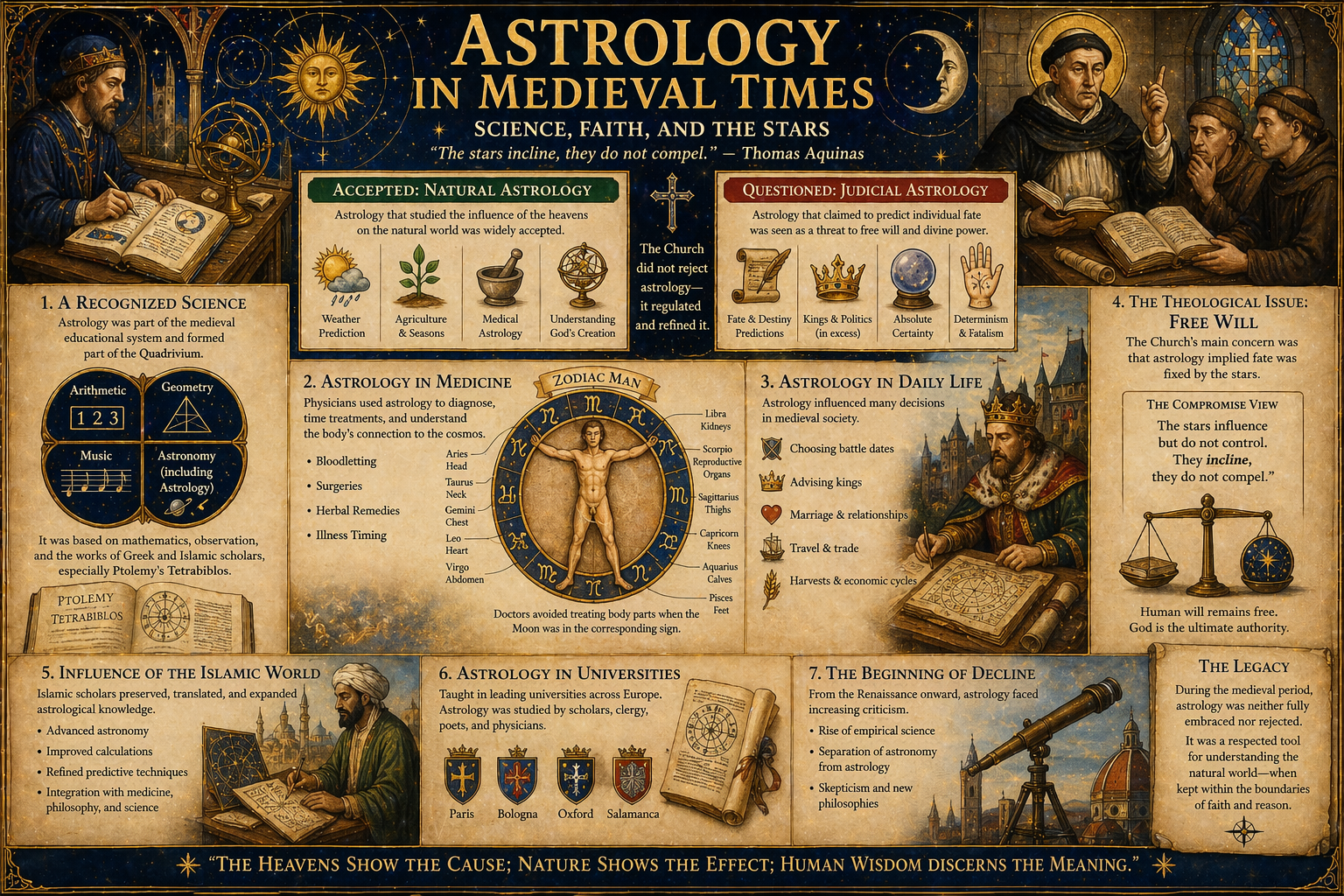
1. Astrology as a Recognized Science
In the medieval worldview, astrology was part of a broader system of knowledge that included astronomy, medicine, and philosophy.
It was grouped under what was known as the quadrivium:
- Arithmetic
- Geometry
- Music
- Astronomy (which included astrology)
Why Astrology Was Respected
- It was based on mathematical calculations
- It relied on observable planetary movements
- It was inherited from Greek and Islamic scholars
Figures like Claudius Ptolemy heavily influenced medieval thought, especially through texts like Tetrabiblos, which framed astrology as a rational system.
2. The Church’s Official Position: Conditional Acceptance
The medieval Church did not reject astrology outright. Instead, it made a key distinction:
Natural astrology was acceptable. Judicial astrology was not.
Natural Astrology (Accepted)
This included:
- Weather prediction
- Agricultural cycles
- Medical astrology (diagnosis and treatment timing)
These uses were seen as:
- Observations of God’s natural order
- Compatible with Christian theology
Judicial Astrology (Controversial or Rejected)
This included:
- Predicting individual fate
- Determining life outcomes
- Making absolute claims about destiny
The Church objected because it conflicted with:
- Free will
- Divine authority
3. The Core Theological Issue: Free Will
The biggest concern was not astrology itself—it was determinism.
Christian doctrine emphasized:
- Humans have free will
- God is the ultimate authority
- The future is not fixed by material forces
If astrology claimed:
“Your life is predetermined by the stars”
—it directly contradicted theology.
The Compromise View
Many theologians adopted a middle position:
The stars influence—but do not control.
This idea became central to medieval astrology.
4. Thomas Aquinas and the Intellectual Framework
One of the most important figures shaping this balance was Thomas Aquinas.
His Position
- Celestial bodies can influence the physical world
- They may affect the body and emotions
- But they cannot determine the soul or will
Key Idea
“The stars incline, they do not compel.”
This became the defining principle that allowed astrology to coexist with Christianity.
5. Astrology in Medicine
Astrology played a major role in medieval medicine.
Physicians used it to:
- Diagnose illness
- Determine treatment timing
- Perform procedures (like bloodletting)
The Zodiac Man
A common diagram used in medicine linked body parts to zodiac signs.
Diagram: Zodiac Man


Example
- Aries → head
- Taurus → neck
- Leo → heart
Doctors avoided treatments when the Moon was in the sign ruling that body part.
6. Astrology in Politics and Daily Life
Astrology was widely used beyond medicine.
Common Uses
- Choosing battle dates
- Advising kings
- Planning marriages
- Predicting harvests
Astrologers like William Lilly later continued this tradition into the early modern period.
7. Influence of the Islamic World
Much of medieval European astrology came through the Islamic Golden Age.
Scholars translated and expanded Greek works, preserving astrology when it might have been lost.
Key contributions included:
- Advanced astronomical calculations
- Refinement of predictive techniques
- Integration with philosophy and medicine
8. Tension and Criticism
Despite its acceptance, astrology was never free from criticism.
Critics Argued
- It could lead to fatalism
- It encouraged reliance on non-Christian systems
- It blurred the line between science and superstition
Church Concerns
- Astrologers making absolute predictions
- Astrology replacing faith
- Association with magic or occult practices
9. Why Astrology Survived
Astrology endured in medieval society because it offered:
1. Practical Value
- Weather forecasting
- Medical timing
- Agricultural planning
2. Intellectual Structure
- Mathematical foundation
- Philosophical integration
3. Compatibility (When Framed Carefully)
By avoiding determinism, astrology could align with theology.
10. The Beginning of Decline
Astrology’s position began to weaken during the Renaissance and Scientific Revolution.
Reasons included:
- Separation of astronomy from astrology
- Rise of empirical science
- Increased skepticism
But during the medieval period, astrology remained:
Respected—but carefully controlled
Final Thoughts
Astrology in medieval times was not simply banned or embraced—it was negotiated.
The Church did not reject astrology entirely. Instead, it:
- Accepted its role in understanding the natural world
- Rejected its claims over human destiny
This balance allowed astrology to:
- Thrive in universities
- Influence medicine and politics
- Remain part of intellectual life
While still being kept within theological limits.
In the medieval world, astrology was not seen as opposing faith—only when it tried to replace it.