
Why This Debate Exists
Modern astrology leans heavily on Uranus, Neptune, and Pluto.
Horary astrology largely… doesn’t.
That’s not because horary is outdated.
It’s because horary is built for one thing:
Clear, testable outcomes
And outer planets often interfere with that clarity.
The Core Problem
Outer planets describe conditions… not actions.
Horary requires:
- Movement
- Application
- Perfection
Outer planets struggle with all three.
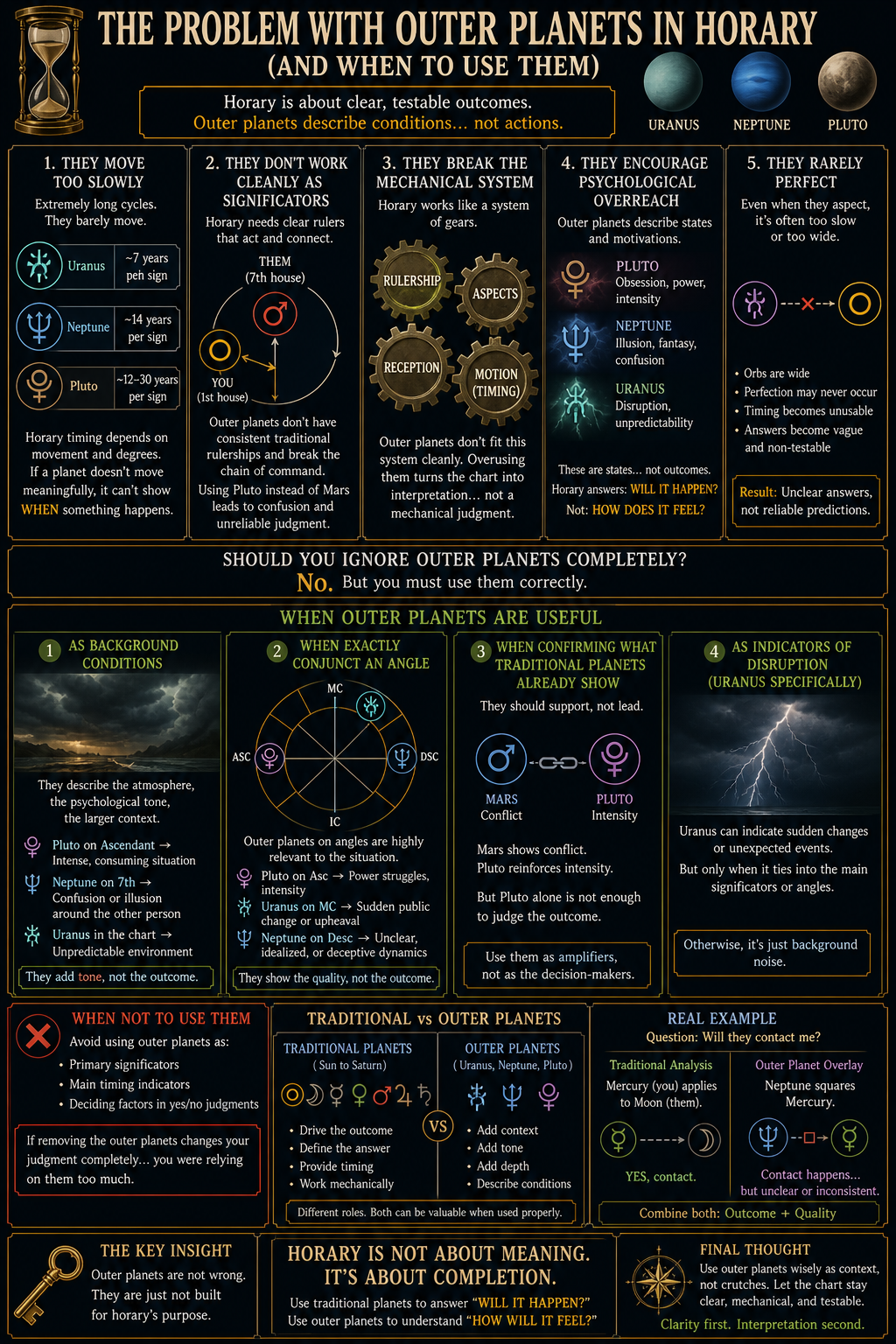
1. They Move Too Slowly


- Uranus: ~7 years per sign
- Neptune: ~14 years per sign
- Pluto: ~12–30 years per sign
In horary terms:
→ They barely move
→ They rarely perfect aspects in a usable timeframe
Why This Matters
Horary timing depends on:
- Degrees
- Motion
- Speed
If a planet doesn’t move meaningfully:
→ It can’t reliably show when something happens
2. They Don’t Work Cleanly as Significators
In horary, every question needs:
- You → 1st house ruler
- Them → 7th house ruler
These rulers must:
→ Act, move, connect
Outer planets:
- Don’t have consistent rulership in traditional systems
- Don’t form clear chains of command
- Don’t integrate cleanly with reception
Result:
Using Pluto as a significator instead of Mars:
→ You lose:
- Clarity
- Structure
- Predictability
3. They Break the Mechanical System


Horary works like a system of gears:
- Rulership → defines roles
- Aspects → define interaction
- Reception → defines cooperation
- Motion → defines timing
Outer planets don’t fit this system cleanly.
When overused:
→ The chart becomes interpretive instead of mechanical
4. They Encourage Psychological Overreach


Outer planets excel at describing:
- Pluto → obsession, power
- Neptune → illusion, fantasy
- Uranus → disruption, unpredictability
These are:
→ states, not outcomes
The Trap
You start saying:
- “There’s deep transformation here”
- “There’s spiritual connection”
But the real horary question is:
→ Will it happen or not?
5. They Rarely Perfect
Even when outer planets aspect:
- The orb may be wide
- The perfection may never occur
- The timing becomes unusable
This leads to:
→ Vague answers
→ Non-testable predictions
So… Should You Ignore Them Completely?
No.
But you need to use them correctly.
When Outer Planets ARE Useful
1. As Background Conditions


Outer planets describe:
- The atmosphere
- The psychological tone
- The larger context
Example:
- Pluto on the Ascendant
→ Situation feels intense, consuming - Neptune on the 7th
→ Confusion or illusion around the other person
2. When Exactly Conjunct an Angle
This is one of the few times they become:
→ Highly relevant
- Pluto on Ascendant → power struggle
- Uranus on MC → sudden public change
- Neptune on Descendant → unclear partner situation
But even here:
→ They describe the quality, not the outcome
3. When Confirming What Traditional Planets Already Show
Outer planets should:
→ Support, not lead
Example:
- Mars shows conflict
- Pluto reinforces intensity
That’s valid.
But Pluto alone:
→ Is not enough to judge outcome
4. As Indicators of Disruption (Uranus Specifically)
Uranus can sometimes indicate:
- Sudden changes
- Unexpected events
But only when:
→ It ties into the main significators or angles
When NOT to Use Outer Planets
Avoid using them as:
- Primary significators
- Main timing indicators
- Deciding factors in yes/no judgments
The Practical Rule
If removing the outer planets changes your judgment completely…
you were relying on them too much.
Traditional vs Modern Use (Clear Boundary)
Traditional Planets
- Drive the outcome
- Define the answer
- Provide timing
Outer Planets
- Add context
- Add tone
- Add depth
Real Example
Question:
“Will they contact me?”
Traditional Analysis:
- Mercury applies to Moon
→ Yes, contact
Outer Planet Overlay:
- Neptune involved
→ Confusion, mixed signals
Final Judgment:
→ Yes, contact happens
→ But unclear or inconsistent
The Key Insight
Outer planets are not wrong.
They’re just:
→ Not built for horary’s purpose
Final Thought
Horary is not about meaning.
It’s about completion.
If you rely on outer planets to answer:
→ “Will this happen?”
You’ll get:
- Beautiful interpretations
- Weak predictions
But if you use them correctly:
→ They enhance the chart
→ Without breaking the system