
Why This Debate Actually Matters
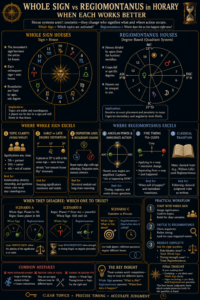
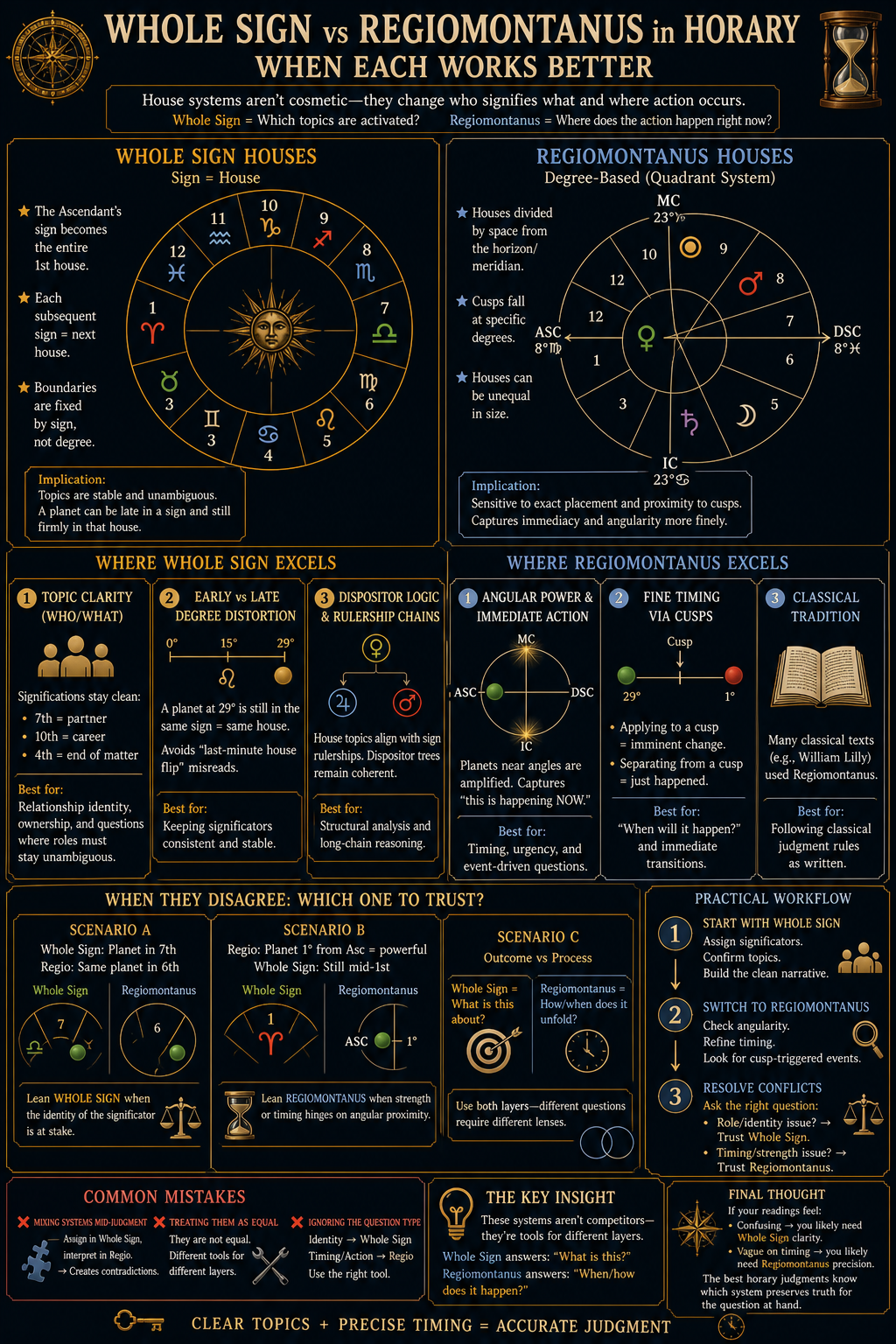
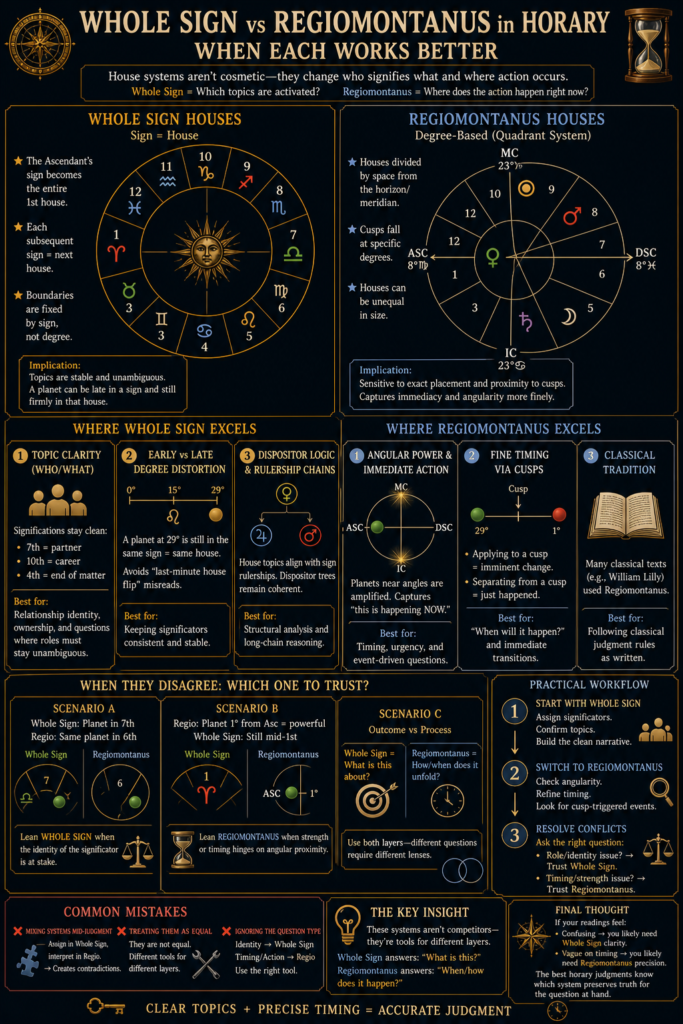
In horary, house systems aren’t cosmetic—they change who signifies what and where action occurs.
- Whole Sign Houses → clean, sign-based structure
- Regiomontanus Houses → degree-based, quadrant precision
Both can work. The question is:
Which one preserves clarity for the question you’re judging?
The Core Difference (In One Line)
- Whole Sign → “Which topics are activated?”
- Regiomontanus → “Where does the action happen right now?”
How Each System Constructs Houses
Whole Sign: Sign = House


- The Ascendant’s sign becomes the entire 1st house
- Each subsequent sign = next house
- Boundaries are fixed by sign, not degree
Implication:
- Topics are stable and unambiguous
- Planet can be late in a sign and still firmly in that house
Regiomontanus: Degree-Based Quadrants


- Houses divided by space from the horizon/meridian
- Cusps fall at specific degrees
- Houses can be unequal in size
Implication:
- Sensitive to exact placement and proximity to cusps
- Captures immediacy and angularity more finely
Where Whole Sign Excels
1) Topic Clarity (Who/What Is Being Asked)
Whole Sign keeps significations clean:
- 7th = partner, period
- 10th = career/public outcome
- 4th = end of the matter
No ambiguity from late-degree cusps.
Best for:
- Relationship identity (“Is this them?”)
- Ownership/possession questions
- When Regio shifts a key planet across a cusp and muddies roles
2) Early vs Late Degree Distortion
In quadrant systems, a planet at 29° can slip houses.
Whole Sign says:
→ It’s still that house, because it’s still that sign.
Best for:
- Avoiding “last-minute house flip” misreads
- Keeping significators consistent
3) Dispositor Logic & Rulership Chains
Because houses align with signs:
- Rulership → house topics map cleanly
- Dispositor trees stay coherent
Best for:
- Structural analysis (who ultimately controls the matter)
- Long-chain reasoning (ruler → ruler → outcome)
Where Regiomontanus Excels
1) Angular Power & Immediate Action


Regiomontanus is excellent for angles:
- Near Asc/MC/Desc/IC = amplified effect
- Captures “this is happening now”
Best for:
- Timing
- Urgency
- Event-driven questions
2) Fine Timing via Cusps
Small degree differences matter:
- Applying to a cusp → imminent change
- Separating from a cusp → just happened
Best for:
- “When will it happen?”
- Tracking immediate transitions
3) Classical Horary Tradition
Many classical texts (e.g., William Lilly) used Regiomontanus.
That tradition is built around:
- Degree-based cusps
- Angular strength
- Precise application/separation
Best for:
- Following classical judgment rules as written
When They Disagree (The Real Test)
This is where skill shows.
Scenario A: Whole Sign Clear, Regio Ambiguous
- Whole Sign: Planet firmly in 7th → “them”
- Regio: Same planet falls into 6th by degree
Lean Whole Sign when:
- Identity of significator is at stake
Scenario B: Regio Shows Angular Hit, Whole Sign Doesn’t
- Regio: Planet 1° from Ascendant → powerful, immediate
- Whole Sign: Still mid-1st
Lean Regio when:
- Strength/timing hinges on angular proximity
Scenario C: Outcome vs Process
- Whole Sign clarifies what the story is about
- Regio clarifies how/when it unfolds
Best practice:
→ Use both layers, but prioritize one for the question type
A Practical Workflow (That Actually Works)
Step 1: Start with Whole Sign
- Assign significators
- Confirm topics
- Build the clean narrative
Step 2: Switch to Regiomontanus
- Check angularity
- Refine timing
- Look for cusp-triggered events
Step 3: Resolve Conflicts
If they disagree, ask:
- Is this a role problem? → trust Whole Sign
- Is this a timing/strength problem? → trust Regio
Common Mistakes
❌ Mixing Systems Mid-Judgment
- Assign significators in Whole Sign
- Then interpret houses in Regio
→ Creates contradictions
❌ Treating Them as Equal in All Cases
They’re not.
- Whole Sign = structural clarity
- Regio = event precision
❌ Ignoring the Question Type
- Identity questions → Whole Sign
- Timing/action questions → Regio
The Key Insight
These systems aren’t competitors—they’re tools for different layers.
- Whole Sign answers: “What is this?”
- Regiomontanus answers: “When/how does it happen?”
Final Thought
If your readings feel:
- Confusing → you likely need Whole Sign clarity
- Vague on timing → you likely need Regiomontanus precision
The best horary judgments don’t pick a side blindly.
They know:
Which system preserves truth for the question at hand.