
Why Timing Is Where Most Readings Fail
Most astrologers can tell what might happen.
Far fewer can tell when.
The gap isn’t intuition—it’s method.
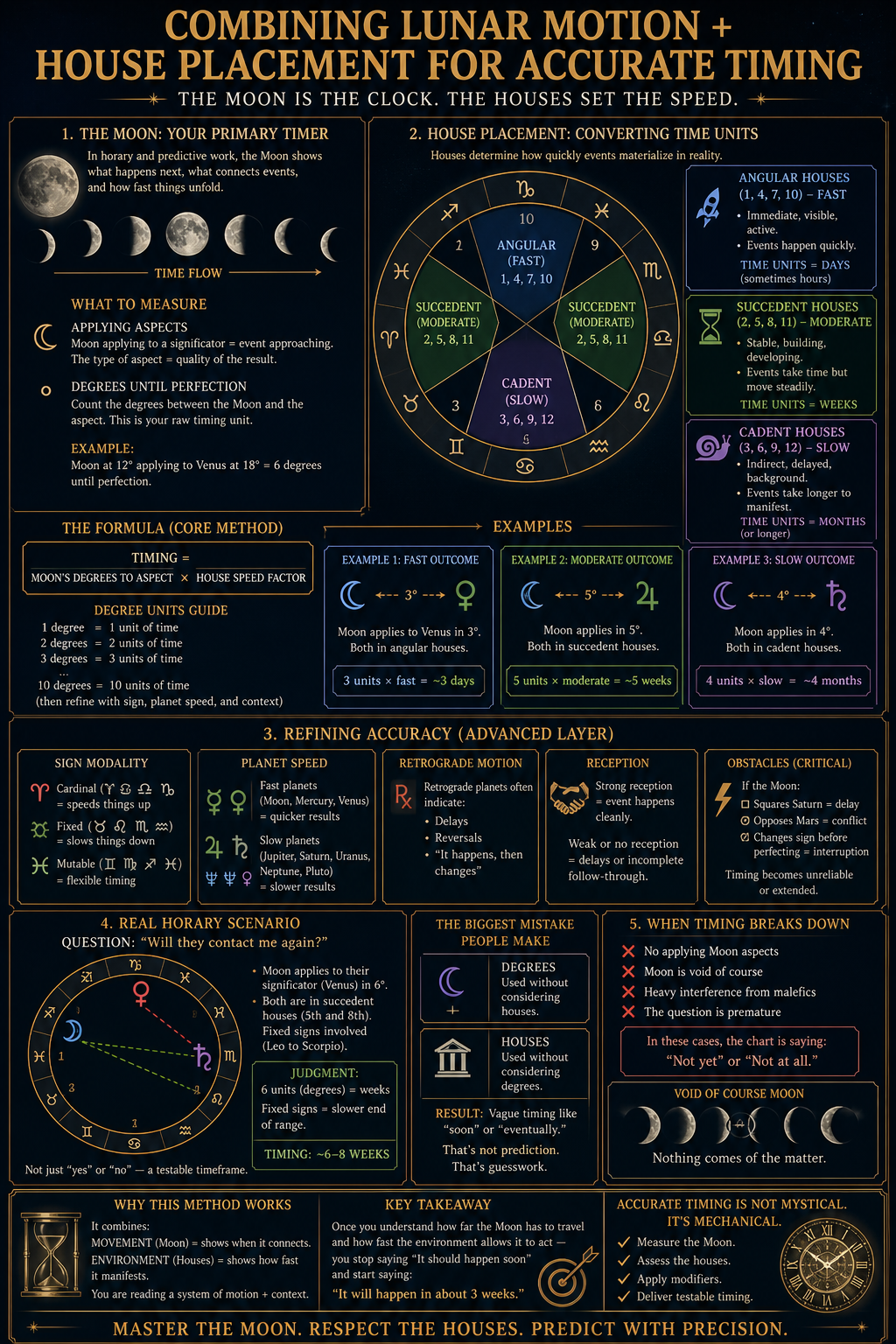
Accurate timing in horary and predictive work comes from combining two things that are often used separately:
- The Moon’s motion → the clock
- House placement → the speed of manifestation
When you layer them together correctly, timing stops being vague… and starts becoming repeatable.
The Moon: Your Primary Timer


In horary, the Moon is not just emotional—it’s mechanical.
It shows:
- What happens next
- What connects events
- How fast things unfold
What to Measure
1. Applying Aspects
- The Moon applying to a significator = event approaching
- The type of aspect = quality (smooth, tense, finalizing)
2. Degrees Until Perfection
- Count the degrees between the Moon and the aspect
→ This is your raw timing unit
Example:
- Moon at 12°
- Target planet at 18°
→ 6 degrees = 6 units of time
But what kind of units?
That’s where house placement comes in.
House Placement: Converting Time Units


Houses determine how quickly events materialize in reality.
The Three Speed Tiers
Angular Houses (1, 4, 7, 10) → FAST
- Immediate, visible, active
- Events happen quickly
→ Units = days (sometimes hours)
Succedent Houses (2, 5, 8, 11) → MODERATE
- Stable, building, developing
- Events take time but move steadily
→ Units = weeks
Cadent Houses (3, 6, 9, 12) → SLOW
- Indirect, delayed, background
- Events take longer to manifest
→ Units = months (or longer)
The Formula (Core Method)
Timing =
Moon’s degrees to aspect × House speed factor
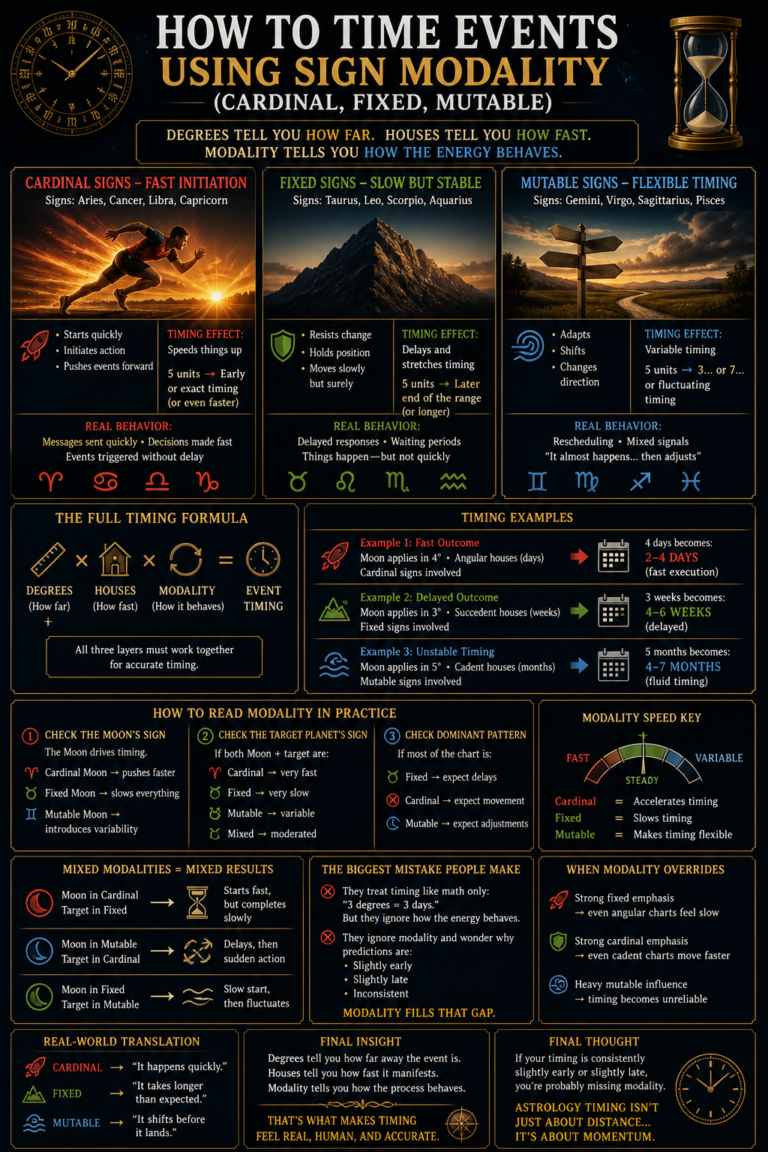
Example 1: Fast Outcome
- Moon applies to Venus in 3 degrees
- Both are in angular houses
→ 3 units × fast = ~3 days
Example 2: Moderate Outcome
- Moon applies in 5 degrees
- Planets in succedent houses
→ 5 units × moderate = ~5 weeks
Example 3: Slow Outcome
- Moon applies in 4 degrees
- Planets in cadent houses
→ 4 units × slow = ~4 months
Refining Accuracy (Advanced Layer)
The basic formula works—but precision comes from modifiers.
1. Sign Modality
- Cardinal (Aries, Cancer, Libra, Capricorn) → speeds things up
- Fixed (Taurus, Leo, Scorpio, Aquarius) → slows things down
- Mutable (Gemini, Virgo, Sagittarius, Pisces) → flexible timing
2. Planet Speed
- Fast planets (Moon, Mercury, Venus) → quicker results
- Slow planets (Saturn) → delays, even in fast houses
3. Retrograde Motion
- Retrograde planets often indicate:
- Delays
- Reversals
- “It happens, then changes”
4. Reception
Even if timing is shown:
- Strong reception → event happens cleanly
- Weak/no reception → delays or incomplete follow-through
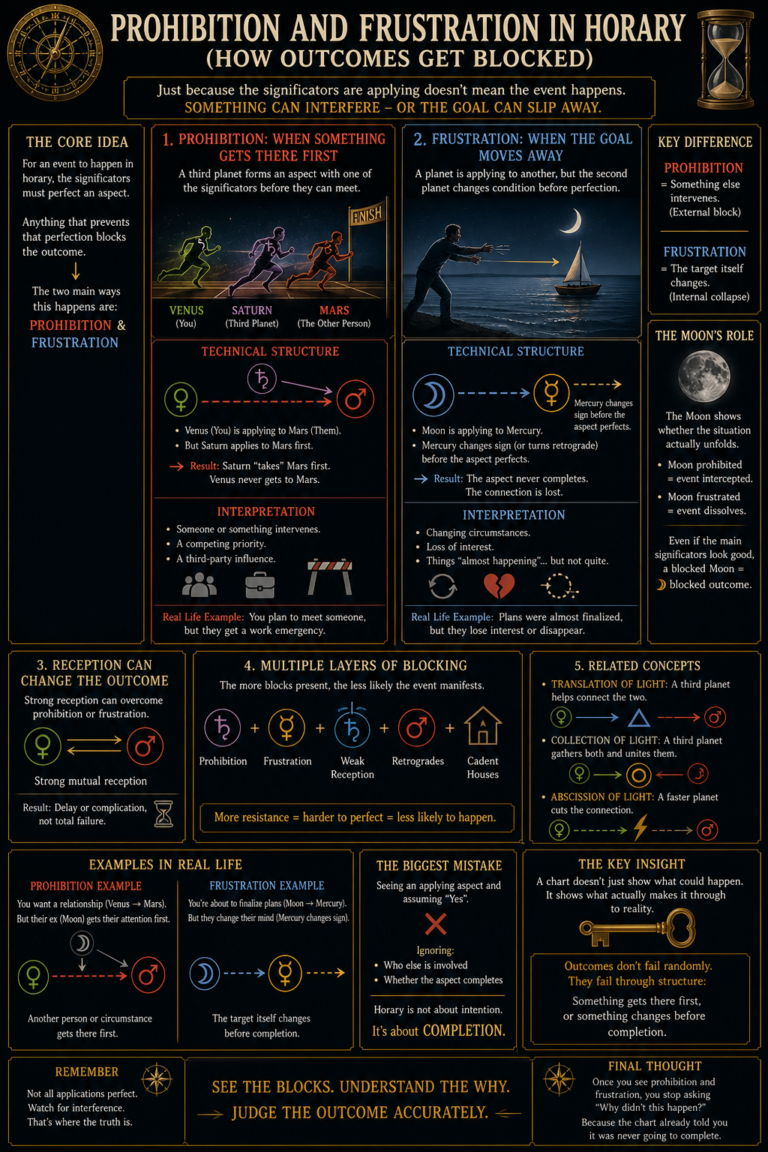
5. Obstacles (Critical)
If the Moon:
- Squares Saturn → delay
- Opposes Mars → conflict
- Changes sign before perfecting → interruption
→ Timing becomes unreliable or extended
Real Horary Scenario
Question: “Will they contact me again?”
Chart shows:
- Moon applies to their significator in 6 degrees
- Both in succedent houses
- Fixed signs involved
Judgment:
- 6 units → weeks
- Fixed signs → slower end of range
→ ~6–8 weeks
Not just “yes” or “no”
→ A testable timeframe
The Biggest Mistake People Make
They use:
- Degrees → but ignore houses
OR - Houses → but ignore degrees
Result:
→ Vague timing like “soon” or “eventually”
That’s not prediction.
That’s guesswork.
Why This Method Works
Because it combines:
- Movement (Moon) → shows when it connects
- Environment (Houses) → shows how fast it manifests
You’re not relying on symbolism.
You’re reading:
→ A system of motion + context
When Timing Breaks Down
Even this method fails when:
- No applying Moon aspects
- Moon is void of course
- Heavy interference from malefics
- Question itself is premature
In those cases:
→ The chart is saying: “Not yet” or “Not at all”
Final Thought
Accurate timing isn’t mystical.
It’s mechanical.
Once you understand:
- How far the Moon has to travel
- And how fast the environment allows it to act
You stop saying:
→ “It should happen soon”
And start saying:
→ “It will happen in about 3 weeks”
That’s the difference between:
- Interpretation
…and prediction.