

Throughout history, humanity has sought guidance from the cosmos. While many people today are familiar with natal astrology based on birth charts, an equally fascinating and ancient branch of astrology exists—horary astrology. Known for its precision and immediacy, horary astrology offers answers to specific questions by interpreting the positions of celestial bodies at the exact moment a query is asked.
This timeless practice stands alongside other divination systems such as tarot and the I Ching, each offering unique insights into life’s uncertainties. Understanding horary astrology not only illuminates its historical importance but also reveals its enduring relevance in modern spiritual practice.
What Is Horary Astrology?
Horary astrology is a method of divination that interprets a chart cast for the precise moment a question is asked. Rather than analyzing a person’s birth chart, it seeks to answer specific inquiries related to love, career, finances, travel, or lost objects.
The word horary originates from the Latin term hora, meaning “hour.” The central principle of horary astrology is that the universe reflects the moment a sincere question arises, allowing astrologers to uncover meaningful answers through celestial symbolism.
Common Questions in Horary Astrology
- Will I find love soon?
- Does this person have feelings for me?
- Will I get the job I applied for?
- Where is my lost item?
- Should I move or stay where I am?
- Is this opportunity worth pursuing?
Horary astrology provides direct, symbolic responses that often reveal not only outcomes but also timing and underlying circumstances.
How Horary Astrology Works
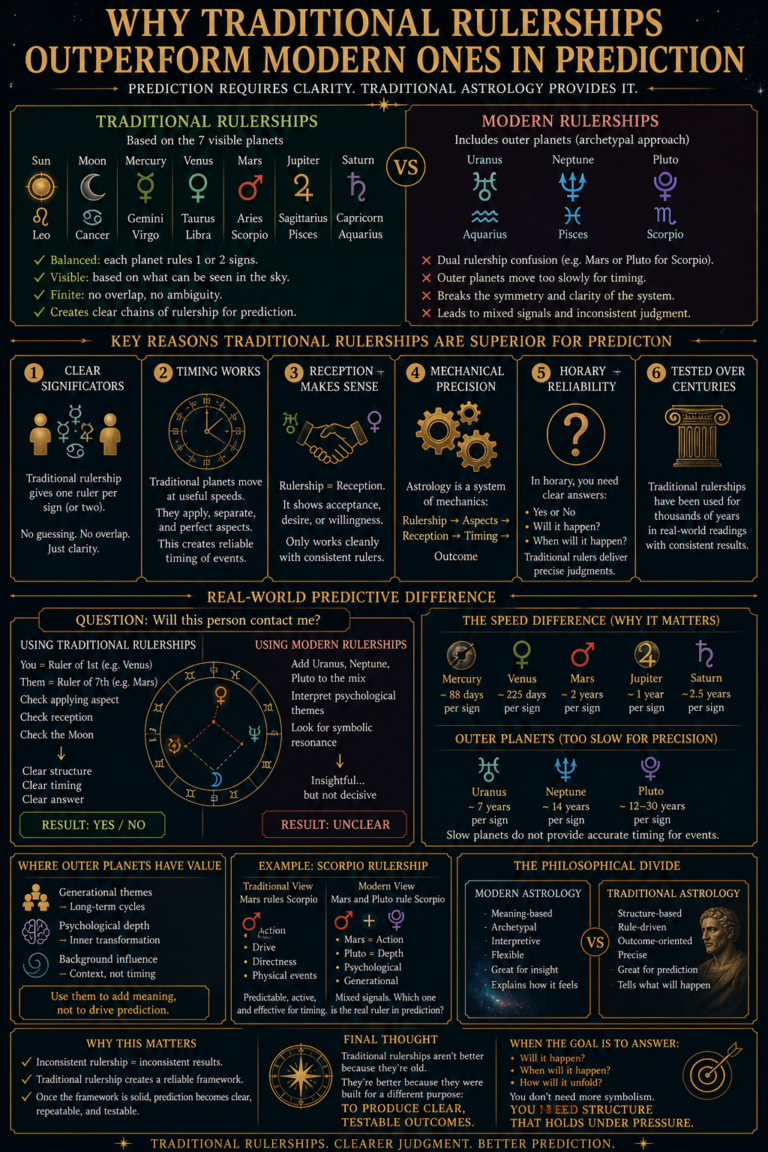
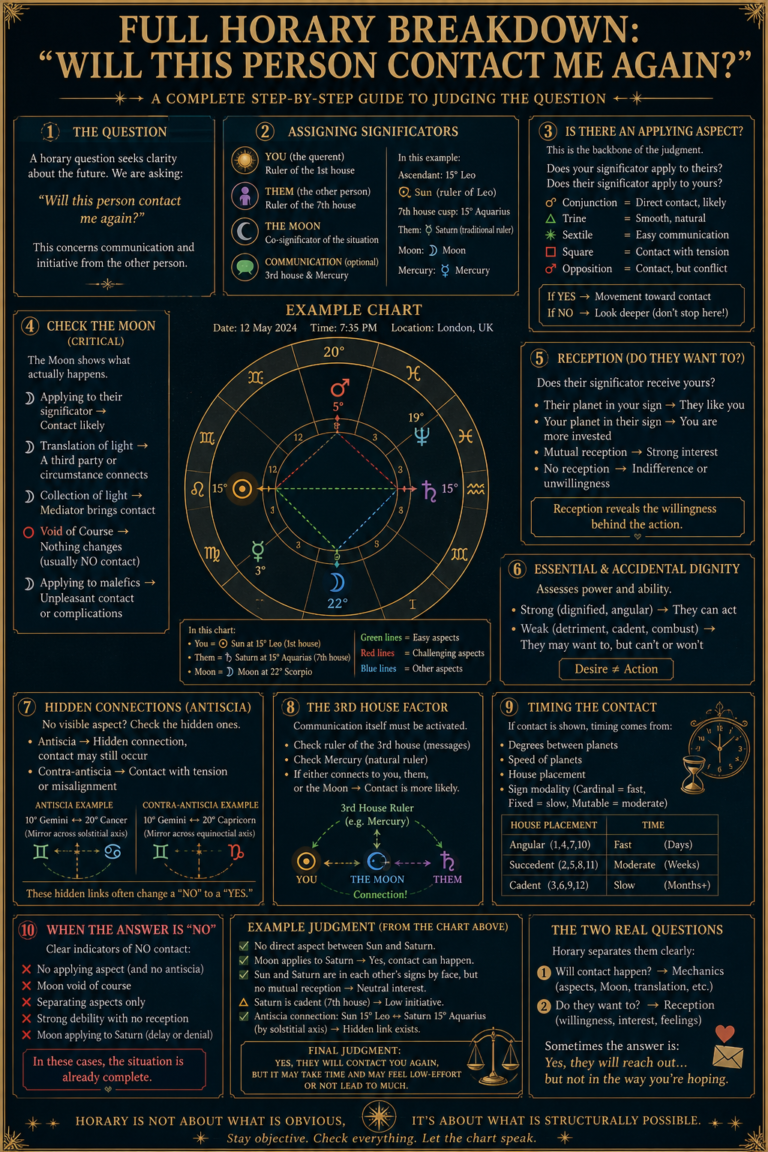
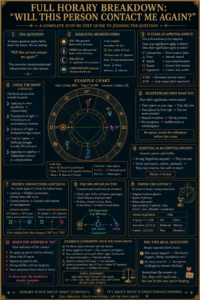
A horary chart is created using the exact time, date, and location where the astrologer receives and understands the question. The astrologer then analyzes planetary placements, aspects, and house rulerships to interpret the answer.
Key Components of a Horary Chart
1. The Ascendant
Represents the person asking the question (the querent).
2. The Houses
Each house corresponds to specific areas of life:
- 1st House: The querent
- 5th House: Romance and pleasure
- 7th House: Partnerships and relationships
- 10th House: Career and reputation
- 2nd House: Finances and possessions
3. Planetary Rulers
Planets represent individuals, events, or circumstances involved in the question.
4. Aspects
The angles between planets reveal developments, obstacles, or resolutions.
5. The Moon
Considered the co-significator in horary astrology, the Moon describes the unfolding of events and the emotional context of the situation.
6. Timing Techniques
Astrologers estimate when events may occur by analyzing planetary movements and degrees between aspects.
Horary Astrology: One of the Earliest Forms of Astrology
Before the widespread use of clocks and accurate birth records, many people did not know their exact birth times. As a result, natal astrology was not always accessible. Horary astrology emerged as a practical solution, allowing astrologers to provide guidance without requiring birth data.
Historical Significance
- Ancient Mesopotamia: Early forms of omen astrology laid the groundwork for horary techniques.
- Hellenistic Greece: Astrologers refined chart interpretation methods.
- Medieval Islamic Scholars: Preserved and expanded astrological knowledge.
- Medieval Europe: Horary astrology flourished during the Renaissance.
- William Lilly (1602–1681): His seminal work Christian Astrology remains the cornerstone of horary practice today.
Because it relied solely on the moment of inquiry, horary astrology became one of the most accessible and widely practiced forms of astrology throughout history.
Horary Astrology vs. Other Forms of Divination
While horary astrology shares a common goal with other divinatory arts—providing insight and guidance—it differs significantly in method and philosophy.
Horary Astrology vs. Tarot
| Feature | Horary Astrology | Tarot |
|---|---|---|
| Method | Planetary positions at the moment of a question | Symbolic interpretation of drawn cards |
| Structure | Mathematical and astronomical | Intuitive and symbolic |
| Focus | Precise answers and timing | Psychological insight and guidance |
| Tools | Astrological chart and ephemeris | Deck of 78 cards |
| Origin | Ancient Mesopotamia, Greece, and Medieval Europe | Renaissance Europe |
| Strength | Accuracy and specificity | Emotional and spiritual clarity |
Summary:
Horary astrology is analytical and structured, while tarot relies more heavily on symbolism and intuition.
Horary Astrology vs. the I Ching
| Feature | Horary Astrology | I Ching |
|---|---|---|
| Origin | Ancient Mesopotamia and Greece | Ancient China |
| Method | Interpretation of celestial alignments | Casting coins or yarrow sticks to form hexagrams |
| Philosophy | Cosmic correspondence and planetary influence | Taoist principles of balance and change |
| Focus | Concrete answers and timing | Guidance on life’s unfolding patterns |
| Structure | Astrological calculations | Symbolic and philosophical interpretation |
| Strength | Specific predictions and clarity | Wisdom-oriented decision-making |
Summary:
Horary astrology excels in answering precise questions, whereas the I Ching offers philosophical insight into life’s natural flow.
Strengths of Horary Astrology
1. Precision and Clarity
Horary provides direct answers to specific questions, often with remarkable accuracy.
2. Timing Predictions
It can indicate when events are likely to occur, making it uniquely practical.
3. Accessibility
Unlike natal astrology, it does not require a birth time.
4. Objectivity
Its structured rules reduce subjectivity in interpretation.
5. Historical Authority
With centuries of documented practice, horary astrology stands as one of the most respected traditional astrological disciplines.
When to Use Horary Astrology
Horary astrology is most effective when:
- A question is sincere and clearly defined.
- Immediate guidance is needed.
- Birth data is unavailable.
- A decisive answer is required.
It is particularly popular in matters of love, career, finance, and personal decision-making.
Final Thoughts
Horary astrology represents one of the oldest and most practical forms of celestial divination. Developed at a time when birth records were scarce, it provided seekers with immediate answers rooted in the belief that the cosmos reflects every moment of human experience.
When compared with tarot and the I Ching, horary astrology stands apart for its mathematical precision and predictive power. Yet, like all divinatory systems, it serves the same ultimate purpose: to illuminate the path forward and deepen our understanding of life’s mysteries.
Whether one consults the stars, draws tarot cards, or casts the coins of the I Ching, each method reflects humanity’s enduring quest for wisdom—and our timeless connection to the universe.