
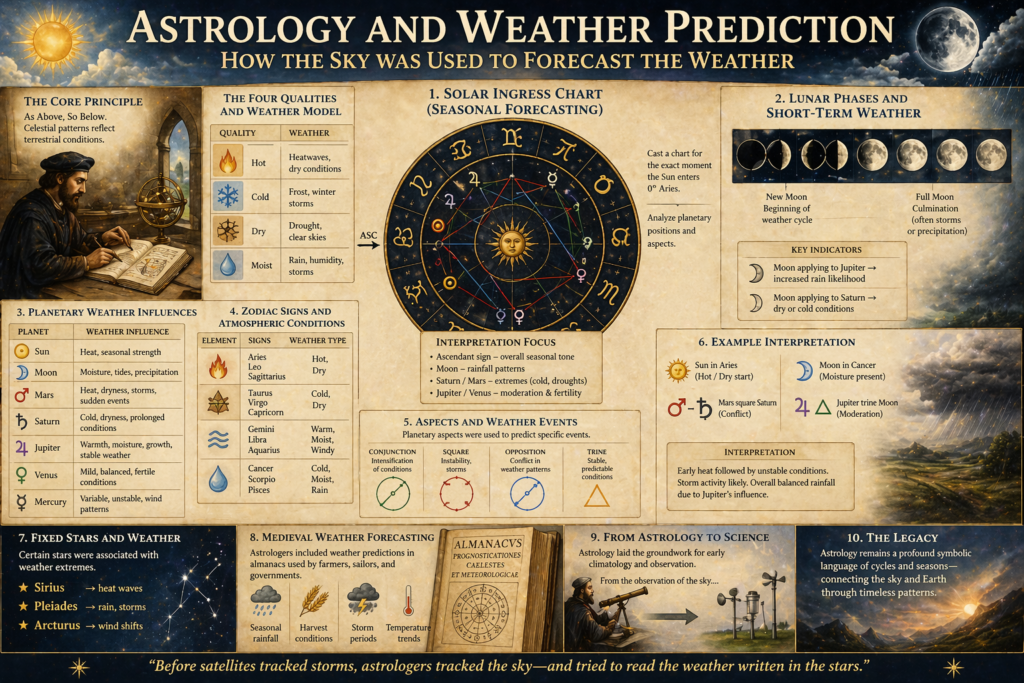
Long before modern meteorology, astrology played a central role in predicting weather patterns. In fact, one of astrology’s earliest and most practical applications was not personality analysis—but forecasting rain, droughts, storms, and seasonal shifts.
Ancient and medieval astrologers treated the sky as a dynamic system where planetary motions correlated with atmospheric conditions. While modern science has replaced astrology in weather prediction, the methodology and observational discipline laid important groundwork for early climatology.
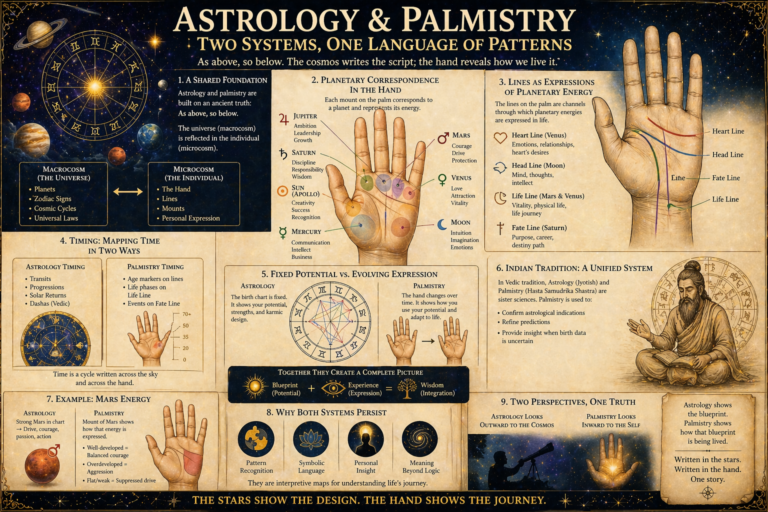
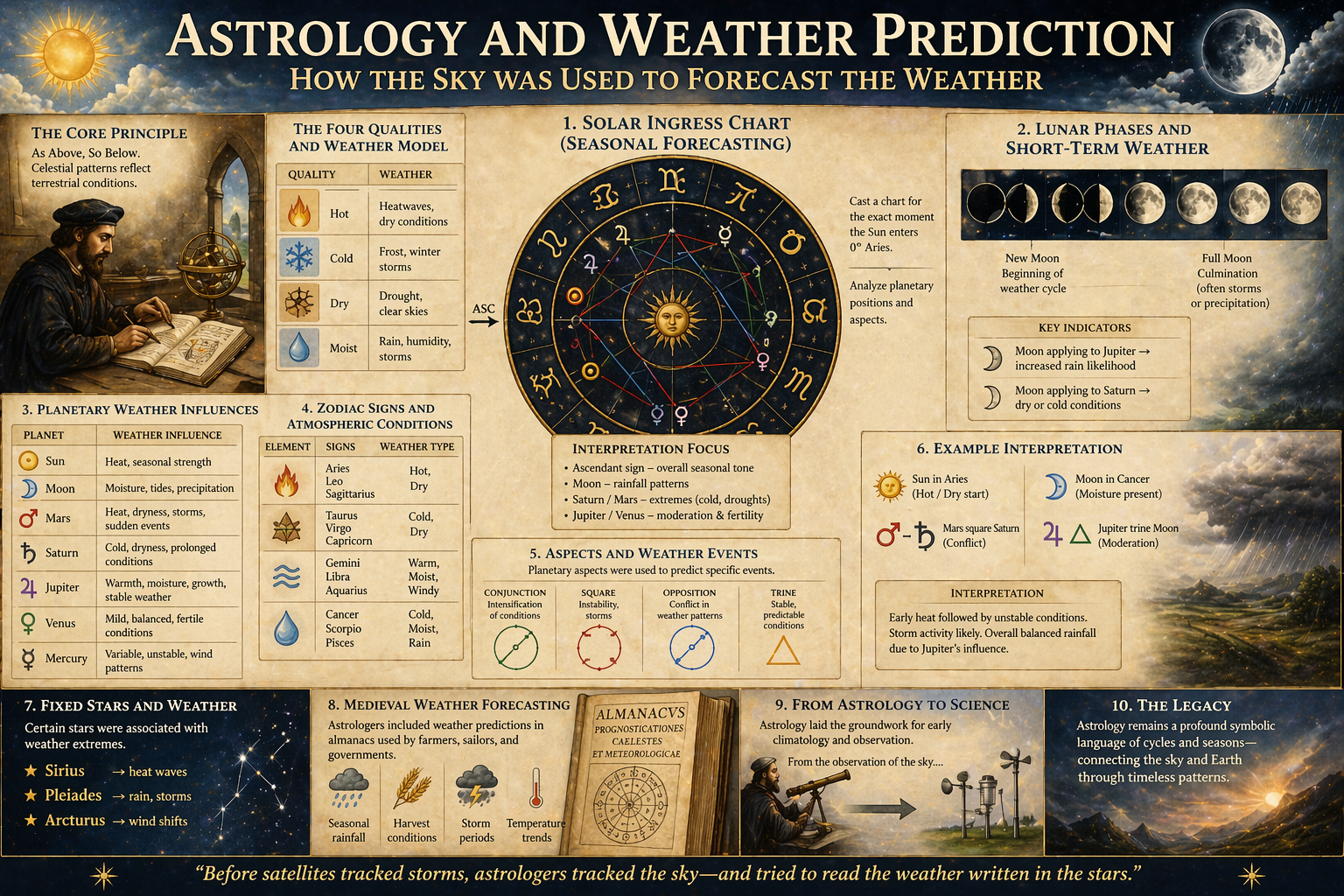
1. The Core Principle: As Above, So Below
Astrological weather prediction is based on the idea that:
Celestial patterns reflect terrestrial conditions
This principle assumes:
- Planets influence elemental balance (hot, cold, dry, moist)
- Atmospheric conditions respond to cosmic cycles
- Seasonal changes align with solar and planetary movement
2. The Four Qualities and Weather Modeling
Traditional astrology uses four fundamental qualities:
| Quality | Associated Weather |
|---|---|
| Hot | Heatwaves, dry conditions |
| Cold | Frost, winter storms |
| Dry | Drought, clear skies |
| Moist | Rain, humidity, storms |
Each planet and zodiac sign carries a combination of these qualities.
3. Planetary Weather Influences
Key Planetary Roles
| Planet | Weather Influence |
|---|---|
| ☉ Sun | Heat, seasonal strength |
| ☽ Moon | Moisture, tides, precipitation |
| ♂ Mars | Heat, dryness, storms, sudden events |
| ♄ Saturn | Cold, dryness, prolonged conditions |
| ♃ Jupiter | Warmth, moisture, growth, stable weather |
| ♀ Venus | Mild, balanced, fertile conditions |
| ☿ Mercury | Variable, unstable, wind patterns |
4. Zodiac Signs and Atmospheric Conditions
Each zodiac sign is classified by element and modality, influencing weather tendencies.
Elemental Influence
| Element | Weather Type |
|---|---|
| Fire (Aries, Leo, Sagittarius) | Hot, dry |
| Earth (Taurus, Virgo, Capricorn) | Cold, dry |
| Air (Gemini, Libra, Aquarius) | Warm, moist, windy |
| Water (Cancer, Scorpio, Pisces) | Cold, moist, rain |
5. The Solar Ingress Chart (Seasonal Forecasting)
One of the most important tools was the solar ingress chart—especially the Sun entering Aries (spring equinox).
How It Works
- Cast a chart for the exact moment the Sun enters 0° Aries
- Use the location of interest (e.g., London, Rome)
- Analyze planetary placements and aspects
Diagram: Solar Ingress Concept


Interpretation Focus
- Ascendant sign → overall seasonal tone
- Moon → rainfall patterns
- Saturn/Mars → extremes (cold snaps, droughts)
- Jupiter/Venus → moderation and fertility
6. Lunar Phases and Short-Term Weather
Astrologers closely tracked the Moon for near-term forecasts.
Key Indicators
- New Moon → beginning of weather cycle
- Full Moon → culmination (often storms or precipitation)
- Moon aspects to planets → triggers
Diagram: Lunar Weather Cycle


Example Rule
- Moon applying to Jupiter → increased rain likelihood
- Moon applying to Saturn → dry or cold conditions
7. Aspects and Weather Events
Planetary aspects were used to predict specific events.
Key Aspects
| Aspect | Effect |
|---|---|
| Conjunction | Intensification of conditions |
| Square | Instability, storms |
| Opposition | Conflict in weather patterns |
| Trine | Stable, predictable conditions |
Diagram: Planetary Aspects


8. The Role of Fixed Stars
Certain stars were associated with weather extremes.
Examples
- Sirius → heat waves
- Pleiades → rain and storms
- Arcturus → wind shifts
These were observed empirically over centuries.
9. Medieval Weather Forecasting Systems
Astrologers like William Lilly included weather predictions in almanacs.
What They Predicted
- Seasonal rainfall
- Harvest conditions
- Storm periods
- Temperature trends
These forecasts were widely used by:
- Farmers
- Sailors
- Governments
10. Example Technical Interpretation
Let’s simulate a simplified forecast:
Chart Indicators
- Sun in Aries (hot/dry start)
- Moon in Cancer (moisture present)
- Mars square Saturn (conflict)
- Jupiter trine Moon (moderation)
Interpretation
- Early heat followed by unstable conditions
- Storm activity likely
- Overall balanced rainfall due to Jupiter influence
11. Why Astrology Was Eventually Replaced
Despite its sophistication, astrology declined as a weather tool due to:
- Lack of consistent measurable accuracy
- Rise of atmospheric science
- Development of instruments (barometers, satellites)
- Mathematical modeling
Modern meteorology focuses on:
- Pressure systems
- Temperature gradients
- Ocean currents
12. What Astrology Still Offers
Even today, astrology provides:
- Long-term symbolic cycles
- Seasonal rhythm awareness
- Historical pattern frameworks
While not scientifically predictive, it remains:
- Structurally elegant
- Historically important
- Conceptually influential
Final Thoughts
Astrology’s role in weather prediction is often overlooked, but it represents one of its most technical and practical applications.
It shows that astrology was never just:
- Personality descriptions
- Daily horoscopes
But a serious attempt to understand:
- Nature
- Cycles
- The relationship between sky and earth
In many ways, astrology was not separate from early science—it was a precursor to it.
Before satellites tracked storms, astrologers tracked the sky—and tried to read the weather written in the stars.