
Among the many techniques in astrology, few are as structured and influential as the Dasha system found in Vedic Astrology. While Western astrology often emphasizes transits and progressions, Indian astrology developed a unique framework for understanding life through planetary time periods.
Known as Dashas (from the Sanskrit word daśā, meaning “state” or “condition”), these systems attempt to answer one of astrology’s most difficult questions:
When will something happen?
But where did this system come from—and how was it developed?
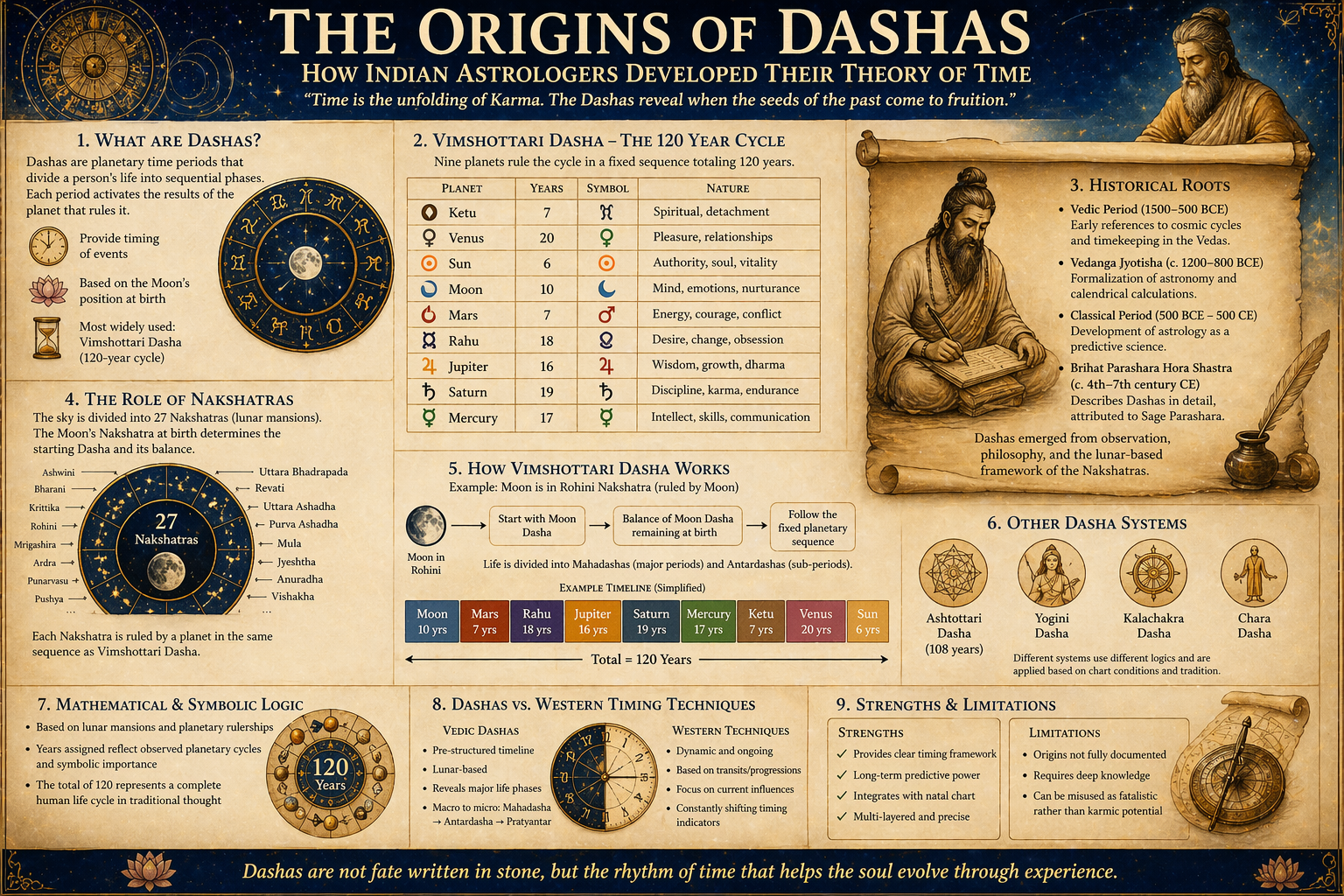
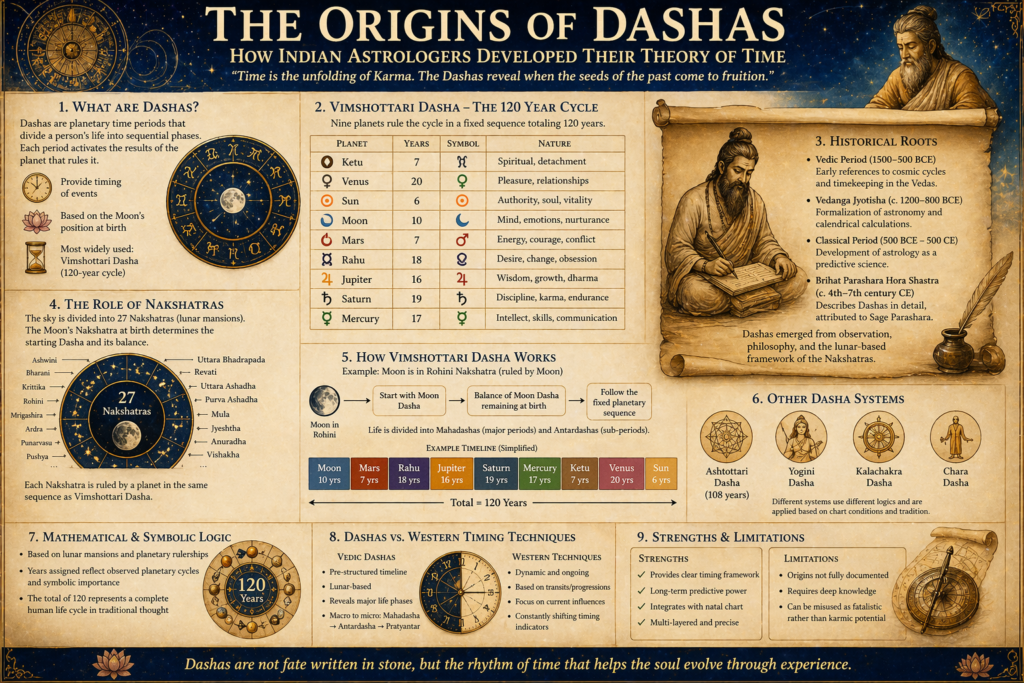
1. What Are Dashas?
Dashas divide a person’s life into sequential periods ruled by planets. Each period is believed to activate certain karmic patterns associated with that planet.
The most widely used system is:
- Vimshottari Dasha (120-year cycle)
Basic Structure
- Life is divided into planetary rulership periods
- Each planet governs a fixed number of years
- Sub-periods (Bhuktis) further refine timing
2. The Historical Roots: Vedic and Post-Vedic India
The origins of Dashas are tied to ancient Indian cosmology and astronomical observation.
Early Foundations
- The Vedas (1500–500 BCE) contain references to cosmic cycles and timekeeping
- The Vedanga Jyotisha (c. 1200–800 BCE) formalized early astronomical calculations
- Time was seen as cyclical, not linear
However, the fully developed Dasha systems appear later in classical astrological texts.
3. The Role of the Nakshatras (Lunar Mansions)
The key to understanding Dashas lies in the Nakshatra system.
What Are Nakshatras?
- The sky is divided into 27 lunar constellations
- Each spans 13°20′ of the zodiac
- The Moon moves through one Nakshatra per day
Why Nakshatras Matter
Dashas are fundamentally:
- Lunar-based timing systems
- Anchored to the Moon’s position at birth
The Nakshatra occupied by the Moon at birth determines:
- The starting Dasha
- The sequence of planetary periods
4. The Development of Vimshottari Dasha
The most influential Dasha system, Vimshottari, is described in texts like the Brihat Parashara Hora Shastra, attributed to the sage Parashara.
Core Structure
The system assigns a total of 120 years to nine planetary rulers:
| Planet | Years |
|---|---|
| Ketu | 7 |
| Venus | 20 |
| Sun | 6 |
| Moon | 10 |
| Mars | 7 |
| Rahu | 18 |
| Jupiter | 16 |
| Saturn | 19 |
| Mercury | 17 |
Why 120 Years?
- Considered the ideal human lifespan in classical Indian thought
- Symbolically represents a complete life cycle
5. Mathematical and Symbolic Logic
The assignment of years is not random.
Possible Influences
- Observational astronomy (planetary cycles)
- Symbolic weighting of planetary importance
- Harmonic divisions of time
- Integration with Nakshatra rulership
Each Nakshatra is ruled by a planet, and the Dasha sequence follows this rulership pattern.
6. How the System Was Likely Developed
While exact origins are not fully documented, scholars suggest a combination of:
1. Empirical Observation
Astrologers tracked:
- Life events
- Planetary periods
- Recurring patterns
Over generations, correlations were refined.
2. Lunar Emphasis in Indian Thought
Unlike Western astrology, which emphasizes the Sun, Indian astrology places strong importance on:
- The Moon (mind, experience, perception)
- Daily and cyclical timekeeping
This made a Moon-based timing system natural.
3. Integration with Karma Theory
Dashas align closely with the concept of karma:
- Life unfolds in phases
- Each phase activates different karmic results
This philosophical framework supported a structured timing system.
7. Other Dasha Systems
Vimshottari is the most common—but not the only one.
Other Systems Include
- Ashtottari Dasha (108 years)
- Yogini Dasha
- Kalachakra Dasha
- Chara Dasha
Each system:
- Uses different logic
- Applies to specific chart conditions
- Reflects alternative timing philosophies
8. Comparison to Western Timing Techniques
Western astrology developed different approaches:
| System | Focus |
|---|---|
| Transits | Current planetary movement |
| Secondary Progressions | Symbolic internal evolution |
| Solar Arcs | Directed planetary motion |
Key Difference
- Western → dynamic, constantly shifting
- Dasha → pre-structured timeline
Dashas provide:
- A predetermined sequence of life phases
- A macro-level structure of time
9. Strengths of the Dasha System
1. Clear Timing Framework
Provides a structured life timeline.
2. Long-Term Predictive Power
Identifies major life phases and themes.
3. Integration with Natal Chart
Dashas activate planets already present in the chart.
4. Multi-Layered Timing
Main periods (Mahadasha) + sub-periods (Antardasha)
10. Limitations and Debates
1. Historical Uncertainty
Exact origins and reasoning behind year assignments are not fully documented.
2. Interpretive Complexity
Requires:
- Deep understanding of planetary conditions
- Integration with transits and divisional charts
3. Determinism Concerns
Can be misinterpreted as rigid fate rather than structured potential.
11. Why Dashas Endured
Despite uncertainties, Dashas remain central to Vedic Astrology because they offer something rare:
A structured answer to timing
They bridge:
- Observation
- Symbolism
- Philosophy
- Mathematics
Final Thoughts
The Dasha system represents one of the most sophisticated attempts in astrology to model time itself.
While its exact origins are partially obscured by history, its structure reflects:
- Deep observation of cycles
- Integration with lunar astronomy
- Philosophical ideas about karma and life stages
Rather than emerging from a single discovery, Dashas likely evolved through:
- Generations of refinement
- Cultural emphasis on cyclical time
- The need to answer when events unfold
In a world where astrology often focuses on personality, Dashas remind us that timing is just as important as identity.