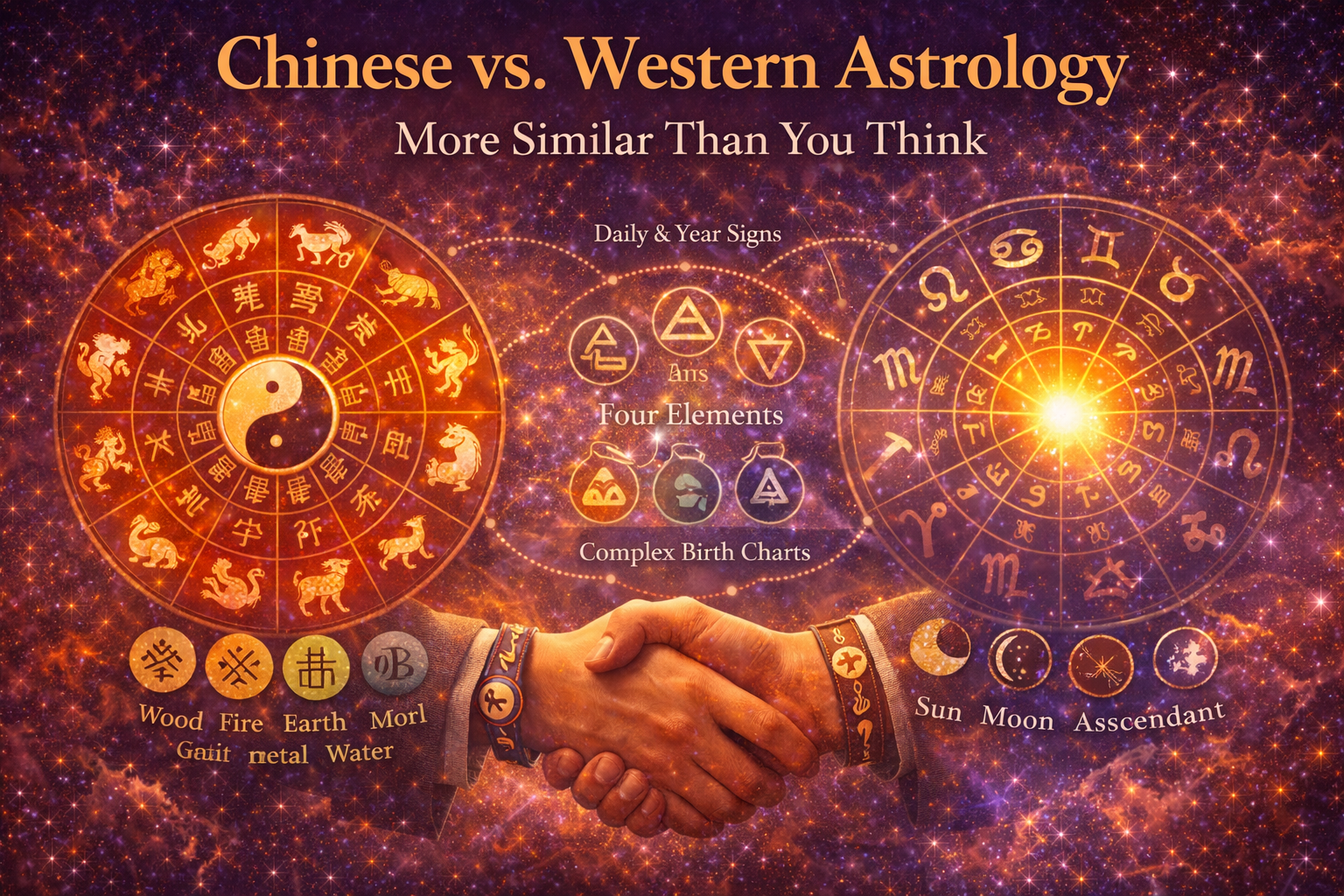
At first glance, Chinese astrology and Western astrology seem completely different.
- One uses animals like Dragon, Tiger, and Rat
- The other uses zodiac signs like Aries, Taurus, and Gemini
But beneath the surface, they share something surprisingly important:
Both systems are widely misunderstood—and simplified in almost identical ways.
Most people think they know astrology. In reality, they often only know the most basic layer.
The Biggest Parallel: Oversimplification
Western Astrology
Most people identify with:
- Their Sun sign
Example:
“I’m a Leo.”
But a full Western chart includes:
- Moon (emotions)
- Rising sign (identity expression)
- Mercury, Venus, Mars (behavior patterns)
- Houses (life areas)
- Aspects (planet interactions)
Chinese Astrology
Most people identify with:
- Their year animal
Example:
“I’m a Dragon.”
But traditional Chinese astrology—especially systems like BaZi (Four Pillars of Destiny)—includes:
- Year pillar (social identity)
- Month pillar (career and environment)
- Day pillar (core self)
- Hour pillar (inner life, future potential)
The Insight
- Western astrology is reduced to Sun sign
- Chinese astrology is reduced to year animal
In both cases, people are using only one layer of a multi-dimensional system.
1. Time-Based Systems at Their Core
Both systems are fundamentally about time cycles.
Western Astrology
Tracks:
- Planetary movement through the zodiac
- Transits and progressions
- Seasonal cycles
Chinese Astrology
Tracks:
- 12-year zodiac cycles
- 10 Heavenly Stems (elements)
- 12 Earthly Branches
- 60-year cycles
Shared Principle
Both systems assume:
Time is not random—it has structure, rhythm, and meaning.
2. Multi-Layered Identity Systems
Both systems build identity through layers, not single labels.
Western Layers
- Sun → core identity
- Moon → emotional nature
- Rising → outward personality
Chinese Layers
- Year → public identity
- Month → environment and work
- Day → true self
- Hour → inner development and future
Common Misconception
People assume:
- “One sign = one personality”
Reality:
- Identity is multi-layered in both systems
3. Element Systems
Both traditions use elements to describe energy.
Western Elements
- Fire (Aries, Leo, Sagittarius)
- Earth (Taurus, Virgo, Capricorn)
- Air (Gemini, Libra, Aquarius)
- Water (Cancer, Scorpio, Pisces)
Chinese Elements
- Wood
- Fire
- Earth
- Metal
- Water
Shared Idea
Elements represent:
- Energy types
- Behavioral tendencies
- Interaction patterns
They’re just expressed differently.
4. Compatibility Is More Complex Than People Think
Western Misconception
“Fire signs match with fire signs.”
Chinese Misconception
“Dragon and Rat are compatible.”
Reality in Both Systems
Compatibility depends on:
- Full chart interaction
- Element balance
- Timing
- Life context
Example
Two people with “compatible” signs:
- May still clash emotionally or mentally
Two “incompatible” signs:
- May have strong overall alignment
5. Both Systems Deal with Cycles, Not Fixed Fate
A major misunderstanding in both traditions:
“Astrology determines your life.”
Western View
Uses:
- Transits
- Progressions
- Solar arcs
To show timing of energy shifts.
Chinese View
Uses:
- Luck cycles (10-year periods)
- Annual influences
- Element cycles
Shared Principle
Astrology indicates:
- Periods of opportunity
- Periods of challenge
—not guaranteed outcomes.
6. Both Systems Were Originally More Technical Than They Are Today
Historically:
Western Astrology
Required:
- Mathematical calculations
- Ephemerides
- House systems
Chinese Astrology
Required:
- Calendar conversions
- Element calculations
- Complex cyclical systems
Modern Shift
Both have been simplified for:
- Mass consumption
- Media
- Social conversation
Result
Depth was traded for:
- Accessibility
- Popularity
- Ease of use
7. Psychological vs. Structural Emphasis
There is one major difference—but even this is narrowing.
Western Astrology (Modern)
Focuses more on:
- Psychology
- Personality
- Self-expression
Chinese Astrology
Focuses more on:
- Life structure
- Timing
- External conditions
But…
Both systems are increasingly blending:
- Western astrology is becoming more predictive again
- Chinese astrology is being used for personal insight
8. The Real Misconception: “They Are Completely Different”
Most people assume:
- Chinese astrology = animals
- Western astrology = personality
But at a deeper level, both systems are trying to answer the same questions:
- Who are you?
- When will things change?
- What patterns shape your life?
- How do you relate to others?
Final Thoughts
Chinese astrology and Western astrology are not opposites—they are parallel systems that evolved in different cultures.
And perhaps the most important similarity is this:
Both are often misunderstood in the exact same way.
- Western astrology reduced to Sun signs
- Chinese astrology reduced to birth year
But behind both lies something much richer:
- Layered identity
- Time-based cycles
- Pattern recognition
- A structured way of understanding life
In both systems, the real insight only begins when you go beyond the surface.
Because whether it’s a Dragon or a Scorpio—one label is never the whole story.