One of the most frequent challenges raised against astrology is simple and compelling:
If astrology is real, how do you explain twins?
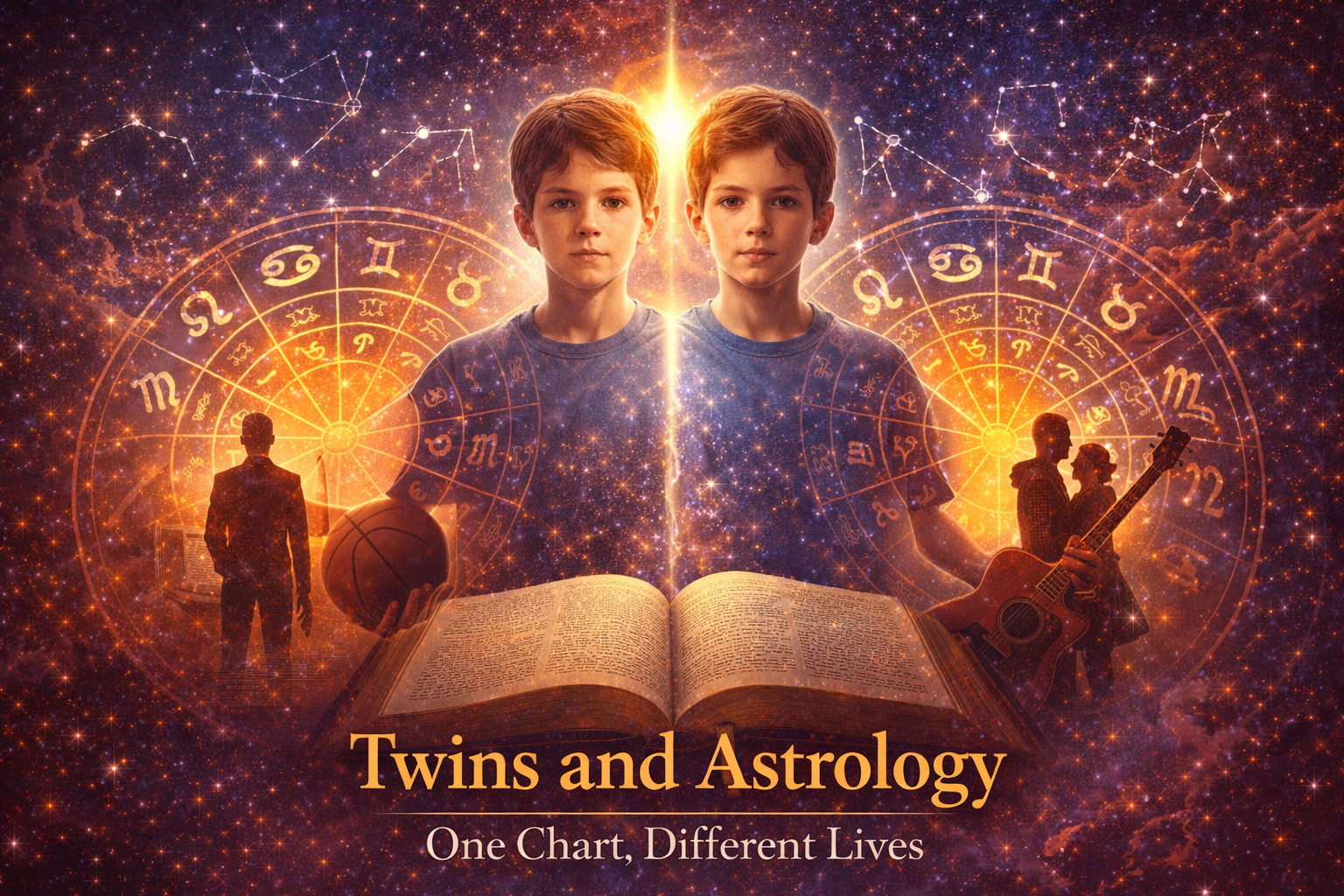
Twins are often born within minutes of each other, share nearly identical natal charts, and grow up in similar environments—yet they can lead remarkably different lives.
At first glance, this seems like a contradiction. But when examined more deeply, twins don’t disprove astrology—they actually reveal how it really works.
The Core Assumption: Same Chart = Same Life
The common expectation is:
- Same birth time
→ Same chart
→ Same personality
→ Same life outcomes
But astrology has never claimed that charts produce identical lives.
Instead, astrology describes:
- Potentials
- Patterns
- Themes
- Timing windows
Not fixed outcomes.
1. Astrology Describes Archetypes, Not Scripts
A natal chart is best understood as a set of archetypal energies.
Think of it like:
- A blueprint
- A personality framework
- A set of tendencies
Two people can express the same energy very differently.
Example
A strong Mars placement could manifest as:
- One twin becoming athletic
- The other becoming argumentative
- Another channeling it into business or ambition
Same energy—different expression.
2. Environment Shapes Expression
Even twins raised together don’t experience life identically.
Subtle differences matter:
- Birth order (even by minutes)
- Parental treatment (often unconscious)
- Social roles (one becomes “the outgoing one,” the other “the quiet one”)
- Life experiences over time
These small divergences compound.
Result
The same chart interacts with slightly different environments → producing different outcomes.
3. The Principle of Differentiation
Twins often unconsciously differentiate themselves.
Why?
Because identity requires contrast.
You’ll often see:
- One twin embodying one side of the chart
- The other expressing a different part
Example
If a chart has:
- Strong emotional (Moon) energy
- Strong logical (Mercury) energy
One twin may become:
- More emotional
The other:
- More analytical
Together, they express the full chart spectrum.
4. House Cusps and Micro-Differences
Even a few minutes can sometimes shift:
- House placements
- Ascendant degrees
- Planetary angles
While subtle, these shifts can:
- Emphasize different life areas
- Change timing of events
- Alter how energy is expressed outwardly
This becomes especially important in:
- Predictive astrology
- Timing techniques
5. Timing Techniques Reveal Differences Over Time
Even if two twins start very similarly, differences emerge through timing systems like:
- Transits
- Secondary progressions
- Solar arcs
A few minutes difference can affect:
- When certain events are triggered
- Which areas of life are activated
Example
- One twin experiences a career breakthrough first
- The other experiences it later—or in a different form
6. Free Will and Choice Still Matter
Astrology provides a framework—but individuals make choices within it.
Two twins with identical charts may:
- React differently to the same opportunity
- Make different decisions under similar pressure
- Develop different habits over time
Over years, these decisions create entirely different life paths.
7. Astrology Works at Multiple Levels
To understand twins, you have to stop thinking of astrology as one-dimensional.
Astrology operates on:
- Psychological level (how you think/feel)
- Behavioral level (how you act)
- Environmental level (what you experience)
- Timing level (when things happen)
Twins may share:
- Similar internal patterns
But differ in:
- Expression
- choices
- timing
- life circumstances
8. Twins Often Share Themes—Not Outcomes
One of the most consistent findings in astrology and twins:
They often experience similar themes, but not identical events.
Examples
- Both experience relationship challenges—but with different partners
- Both pursue success—but in different careers
- Both go through major transitions—but at slightly different times
Astrology aligns the story structure, not the exact scenes.
9. Real-World Observations of Twins
Astrologers who study twins often notice:
Common Patterns
- Shared personality traits
- Similar emotional responses
- Parallel life themes
Key Differences
- Career paths
- relationship choices
- timing of major events
- how energies are expressed
This reinforces that astrology is about pattern alignment, not duplication.
So… Do Twins Disprove Astrology?
Actually, they do the opposite.
Twins reveal that astrology is not:
- Deterministic
- Literal
- Event-specific
But instead:
- Symbolic
- Flexible
- Multi-layered
A Better Way to Understand Astrology
Instead of thinking:
“Astrology tells you exactly what will happen.”
A more accurate model is:
“Astrology describes the types of experiences and tendencies you’re likely to encounter—and how you might respond to them.”
Final Thoughts
Twins challenge the simplistic view of astrology—but they support a deeper one.
They show that:
- The chart is a framework, not a fate
- Expression matters more than structure
- Small differences create divergence over time
- Life is shaped by both pattern and choice
In many ways, twins are the perfect example of how astrology actually works:
The same sky can produce two different stories—because interpretation, environment, and choice shape the outcome.