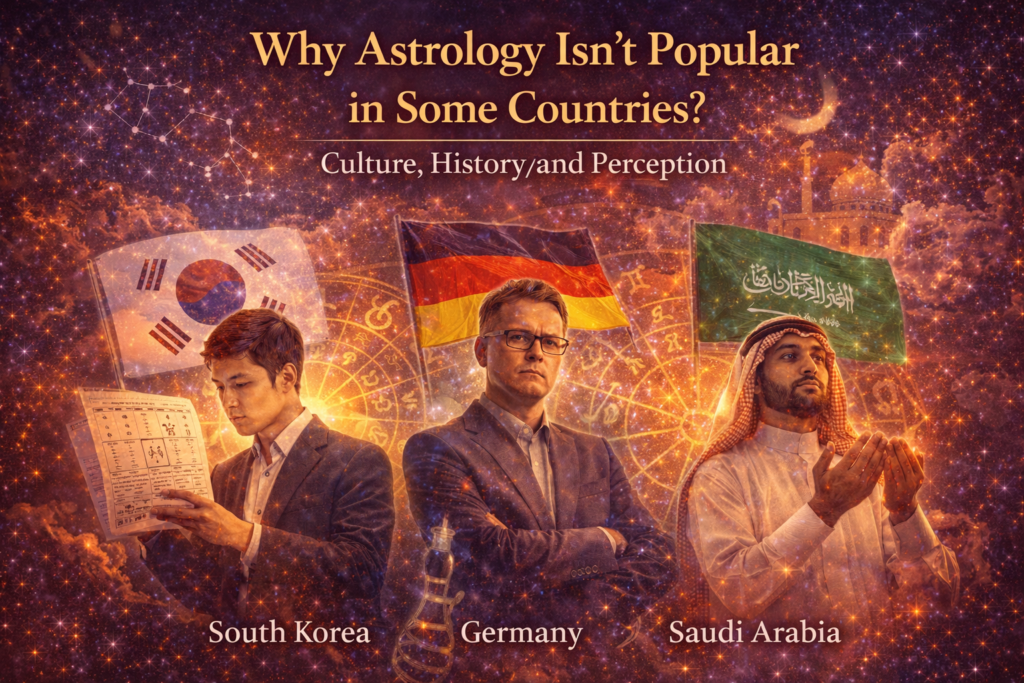
Astrology may feel globally dominant—especially in Western media and online spaces—but its popularity varies dramatically depending on where you are in the world.
In some countries, astrology is:
- Widely accepted
- Deeply integrated into daily life
- Used for major life decisions
In others, it is:
- Viewed skeptically
- Considered entertainment at best
- Or overshadowed by alternative systems
So why the difference?
The answer lies in culture, history, religion, and modernization.
1. Korea: Social Structure Over Cosmic Identity
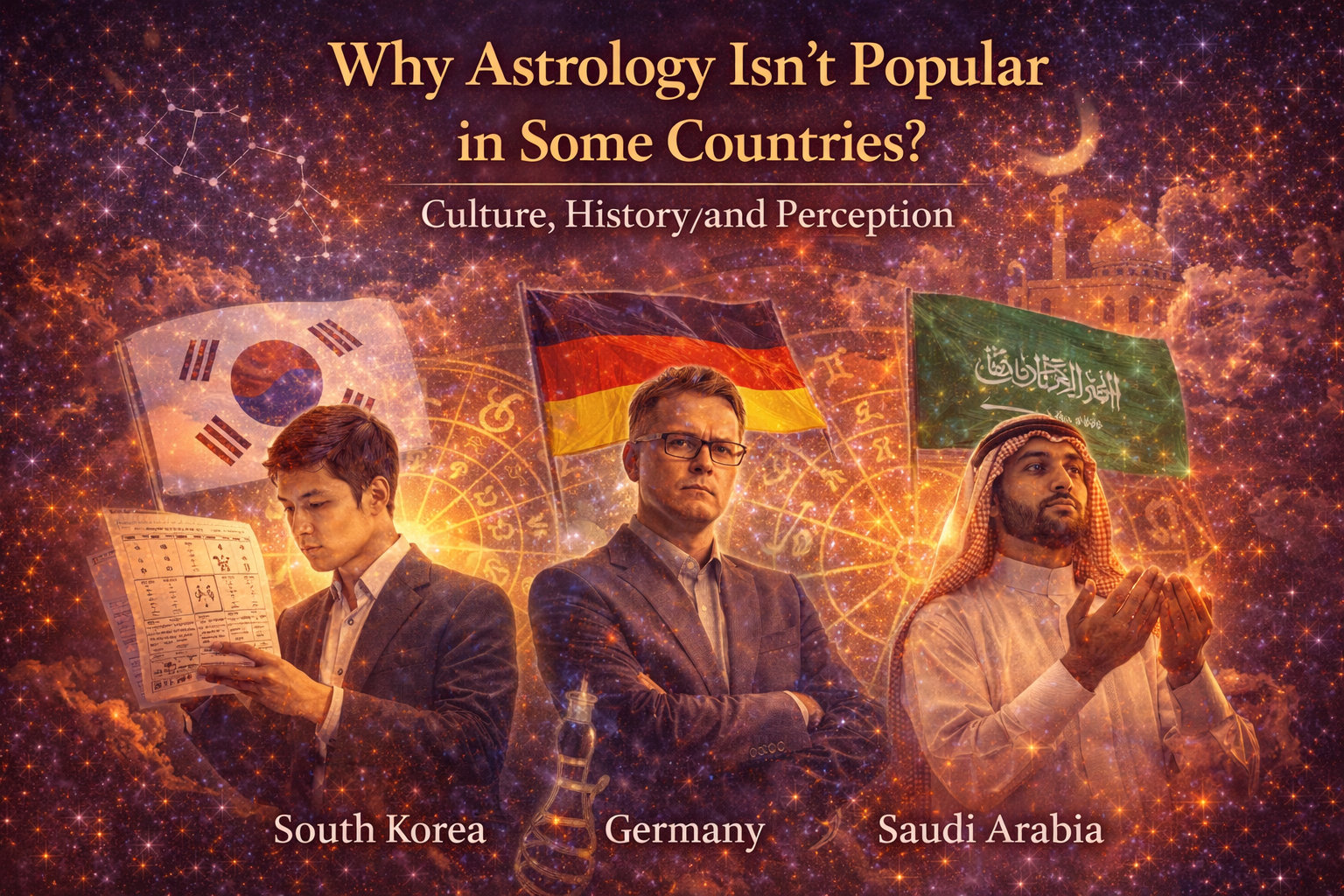
South Korea is a fascinating case. While astrology exists, Western-style zodiac astrology is not a dominant framework for understanding people or relationships.
What Korea Uses Instead
Korea has its own traditional systems:
- Saju (Four Pillars of Destiny)
- Chinese zodiac cycles
- Element-based personality analysis
These systems are often:
- More detailed than Sun sign astrology
- Used for marriage compatibility
- Consulted for career and life decisions
Why Western Astrology Isn’t Mainstream in Korea
1. Strong Social Frameworks
Korean dating and social life often rely more on:
- Social circles
- Introductions (blind dates)
- Group dynamics
Rather than abstract personality systems.
2. Cultural Pragmatism
Korean culture tends to emphasize:
- Practical outcomes
- Social harmony
- Real-world behavior
Astrology—especially simplified forms—can feel too abstract or general.
3. Preference for Structured Systems
Saju, for example:
- Uses exact birth time
- Involves elements and cycles
- Feels more “systematic” and precise
This aligns more with cultural expectations than casual zodiac traits.
Key Insight
Astrology isn’t absent in Korea—it’s just localized differently.
2. Germany: Scientific Skepticism
Germany represents a different type of resistance.
Cultural Traits
- Strong emphasis on science and logic
- High value placed on empirical evidence
- Skepticism toward non-verifiable systems
Why Astrology Struggles Here
1. Scientific Culture
Astrology is often dismissed because:
- It lacks empirical proof
- It is seen as non-scientific
2. Educational Influence
Higher education systems reinforce:
- Critical thinking
- Evidence-based reasoning
Which can make astrology appear irrational.
3. Cultural Identity
In some European countries, belief in astrology may be viewed as:
- Naive
- Unintellectual
- Or unserious
Key Insight
In Germany, astrology’s challenge isn’t cultural tradition—it’s intellectual resistance.
3. China: Astrology Exists, But Differently
China has a long history of astrology—but not in the Western sense.
Dominant Systems
- Chinese zodiac (12 animals)
- Five Elements (Wu Xing)
- BaZi (Four Pillars)
Why Western Astrology Isn’t Dominant
1. Strong Native Systems
Chinese metaphysics already provides:
- Personality analysis
- Timing cycles
- Compatibility frameworks
There is less need for Western astrology.
2. Government and Cultural Shifts
Modern China emphasizes:
- Scientific progress
- Secular governance
Which can limit overt promotion of metaphysical systems.
3. Cultural Continuity
People often trust traditional Chinese systems more because:
- They are culturally rooted
- Passed down generationally
Key Insight
In China, astrology isn’t unpopular—it’s just not Western astrology.
4. Middle Eastern Countries: Religious Influence
In many Middle Eastern regions, astrology faces resistance due to religion.
Key Factor: Islam
In Islamic tradition:
- Certain forms of astrology are discouraged or prohibited
- Divination is often viewed as conflicting with divine will
Why Astrology Is Less Visible
1. Theological Concerns
Astrology may be seen as:
- Challenging God’s authority
- Attempting to predict fate
2. Cultural Norms
Public expression of astrology can be:
- Socially discouraged
- Viewed as inappropriate
Important Distinction
Historically, the Islamic world actually:
- Preserved astrological texts
- Advanced astronomy and astrology
But modern interpretations have shifted.
Key Insight
In these regions, astrology’s decline is tied to religious interpretation, not lack of historical presence.
5. The United States: Why It Became Popular
To understand where astrology is less popular, it helps to see where it thrives.
United States is one of the biggest hubs for modern astrology.
Why It Works There
- Individualism (focus on identity)
- Openness to self-exploration
- Media and entertainment influence
- Simplification (Sun sign astrology)
Astrology fits into a culture that values:
- Personal branding
- Psychological insight
- Self-discovery
The Core Factors That Shape Astrology’s Popularity
Across all countries, a few key variables determine whether astrology thrives or struggles:
1. Cultural Frameworks
- Strong existing systems → less need for astrology
- Example: China, Korea
2. Religious Beliefs
- Astrology may conflict with theology
- Example: Middle East
3. Scientific Orientation
- Higher emphasis on empirical proof → more skepticism
- Example: Germany
4. Social Structure
- Group-based societies rely less on abstract identity systems
- Example: Korea
5. Media and Accessibility
- Simplified astrology spreads faster
- Example: United States
A Bigger Realization
Astrology’s popularity is not just about whether it “works.”
It’s about:
- How it fits into a culture
- What needs it fulfills
- Whether it aligns with dominant belief systems
Final Thoughts
Astrology is not universally accepted—but it is universally adaptable.
In some places, it thrives as:
- Identity language
- Psychological tool
- Cultural trend
In others, it exists quietly as:
- Traditional systems
- Private consultation
- Historical knowledge
And in some, it is resisted altogether.
But across all regions, one thing remains consistent:
People are always looking for patterns, meaning, and understanding—whether through astrology or something else.
Astrology is just one of many ways humans try to answer the same question:
“Why am I the way I am?”