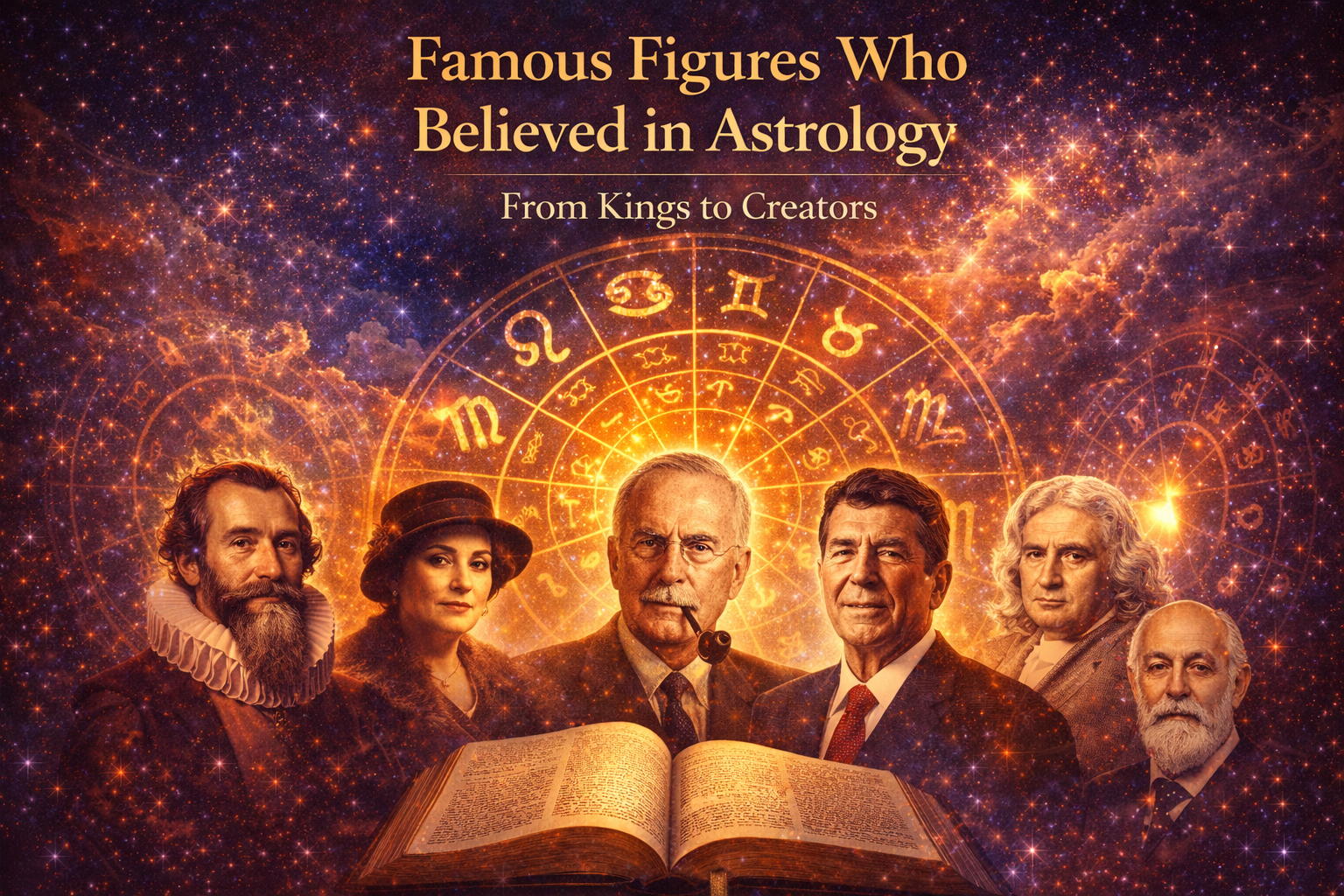
Astrology has never been confined to the margins of society. Across centuries, some of the most influential figures in politics, science, art, and culture have engaged with or openly believed in astrology.
While modern debates often question astrology’s validity, history reveals a more nuanced reality: astrology has long been intertwined with intellectual thought, decision-making, and personal philosophy.
This article explores notable individuals who have expressed belief in—or serious engagement with—astrology.
1. Claudius Ptolemy – The Scientific Foundation
One of the most important figures in both astronomy and astrology, Claudius Ptolemy did not see the two fields as separate.
His Contribution
- Authored Tetrabiblos, a foundational astrological text
- Attempted to explain astrology through natural laws
- Framed astrology as a rational, structured system
Why It Matters
Ptolemy’s work shows that astrology was once considered part of scientific inquiry, not separate from it.
2. Johannes Kepler – The Reluctant Believer
Known for his laws of planetary motion, Johannes Kepler is a surprising name on this list.
His Relationship with Astrology
- Practiced astrology professionally
- Created horoscopes for income
- Critiqued overly superstitious approaches
- Believed in planetary influence, but sought to refine it
Why It Matters
Kepler represents a middle ground:
- Skeptical of blind belief
- Yet convinced there was something real worth studying
3. William Lilly – The Public Authority
William Lilly brought astrology into mainstream English society.
His Influence
- Predicted political events during the English Civil War
- Published widely read almanacs
- Became one of the most trusted astrologers of his time
Why It Matters
Lilly shows that astrology was once:
- Publicly respected
- Politically influential
- Widely consulted
4. Carl Jung – The Psychological Bridge
Perhaps one of the most important modern thinkers to engage with astrology, Carl Jung viewed it as a symbolic system tied to the unconscious.
His Perspective
- Linked astrology to archetypes and the psyche
- Explored synchronicity (meaningful coincidence)
- Used astrology in psychological case studies
Why It Matters
Jung reframed astrology as:
- A psychological language, not superstition
- A tool for understanding human behavior
5. Ronald Reagan – Astrology in Politics
One of the most famous modern examples, Ronald Reagan reportedly relied on astrology during his presidency.
What Happened
- His wife, Nancy Reagan, consulted astrologer Joan Quigley
- Astrological advice influenced scheduling
- Key events were timed based on planetary alignments
Why It Matters
Astrology was used not casually—but at the highest level of political power.
6. Alan Leo – The Modern Revivalist
Alan Leo played a crucial role in making astrology accessible to the public.
His Contribution
- Popularized Sun sign astrology
- Shifted focus toward personality and psychology
- Made astrology readable for everyday people
Why It Matters
Leo helped astrology survive into the modern era by making it:
- Simpler
- More relatable
- More psychologically oriented
7. Evangeline Adams – The Legitimizer
Evangeline Adams helped defend astrology legally and socially.
Her Impact
- Won a court case defending astrology as legitimate
- Consulted high-profile clients
- Elevated astrology’s credibility in the U.S.
Why It Matters
She helped shift astrology from:
- Illegal fortune-telling
to - A respected advisory practice
8. Isaac Newton (Debated Influence)
While not an astrologer, Isaac Newton was deeply involved in alchemy and esoteric studies.
Why He’s Mentioned
- Studied hidden patterns in nature
- Explored symbolic and non-empirical systems
- Lived in a time when astrology and science overlapped
Why It Matters
Even figures associated with rational science were not entirely separate from mystical inquiry.
9. Modern Celebrities and Cultural Figures
Today, astrology continues to influence public figures.
Examples
- Musicians referencing zodiac signs in lyrics
- Actors discussing birth charts in interviews
- Entrepreneurs exploring astrology for self-awareness
Astrology has become:
- A cultural language
- A personal identity tool
- A shared framework for discussion
Why So Many Influential People Turn to Astrology
Across all these figures, a pattern emerges.
Astrology Offers:
1. Pattern Recognition
A way to make sense of complex life events.
2. Timing Awareness
Understanding cycles rather than randomness.
3. Psychological Insight
A framework for personality and behavior.
4. Decision Support
Not replacing judgment—but informing it.
Skepticism Still Exists
It’s important to acknowledge:
- Many scientists reject astrology
- Empirical validation remains debated
- Popular astrology is often oversimplified
But belief in astrology has never been about unanimous agreement—it has always existed alongside skepticism.
Final Thoughts
The history of astrology is not one of obscurity—but of influence.
From Claudius Ptolemy to Carl Jung to Ronald Reagan, astrology has attracted individuals who were:
- Curious
- Analytical
- Interested in patterns and meaning
Whether viewed as science, symbolism, or philosophy, astrology has consistently appealed to those seeking to understand the structure behind human experience.
Belief in astrology has never been universal—but it has never been insignificant either.