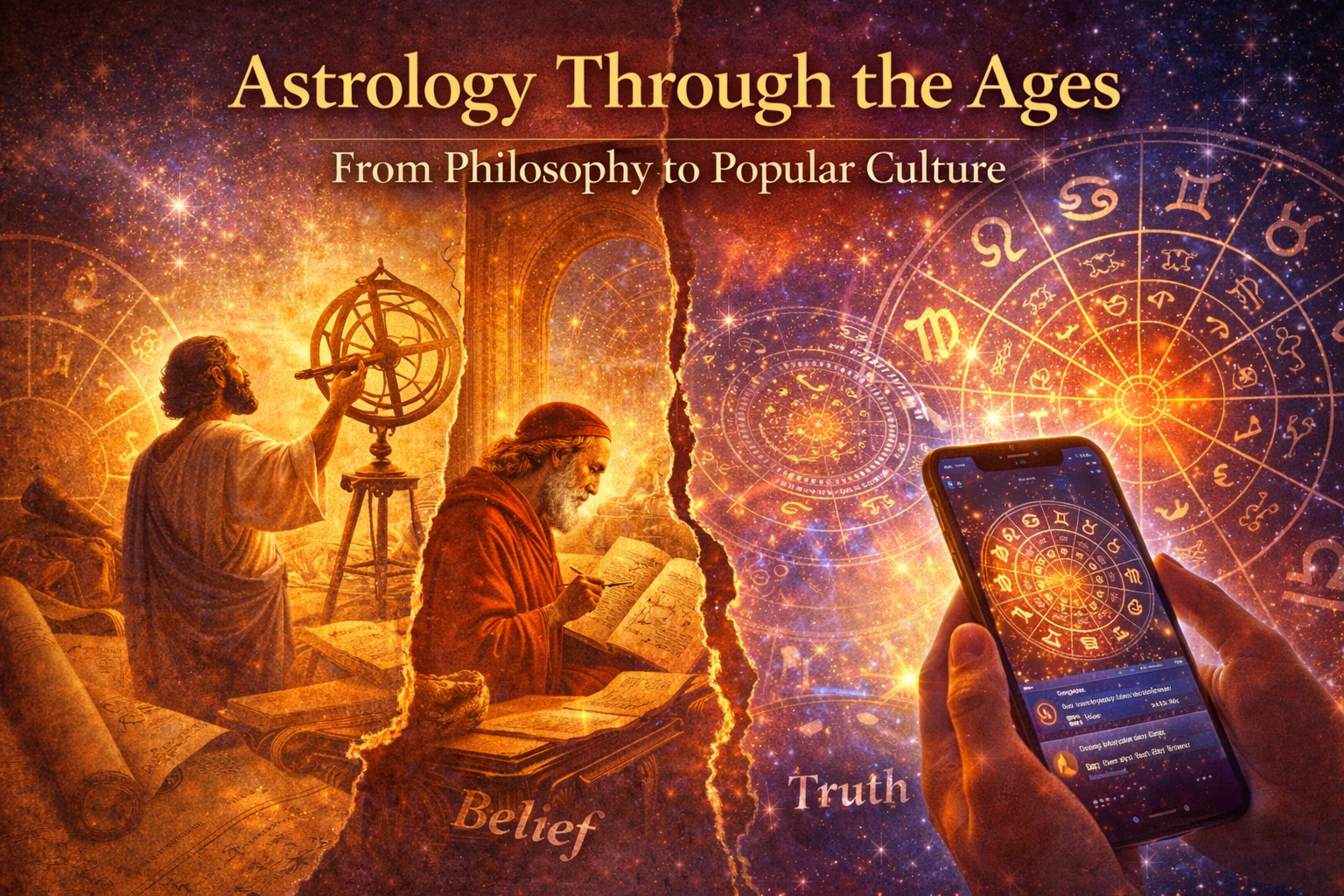
Astrology has never had a static reputation. Across history, it has moved between reverence and ridicule, science and superstition, elite tool and mass entertainment. Its credibility has not declined in a straight line—it has shifted with culture, philosophy, and technology.
To understand astrology today, you have to understand how it was perceived in three major eras:
- The Greek (Hellenistic) world
- The Medieval and Renaissance period
- The Modern era
Each phase reshaped astrology’s trust, authority, and purpose.
1. Greek (Hellenistic) Astrology: A System of Cosmic Order
Astrology as we recognize it today was formalized during the Hellenistic period (roughly 2nd century BCE to 7th century CE). This was the era when astrology became a structured, technical system.
Reputation: Highly Respected and Intellectual
In the Greek world, astrology was not fringe—it was part of natural philosophy.
Astrologers were often:
- Mathematicians
- Astronomers
- Philosophers
Figures like Claudius Ptolemy treated astrology as a rational discipline. His work Tetrabiblos attempted to explain astrology in logical, almost scientific terms.
Why Astrology Was Trusted
- It was tied closely to astronomy (then considered a science)
- It followed mathematical principles
- It aligned with philosophical ideas about cosmic order
- It was used by rulers and intellectual elites
Core Belief
The universe was ordered, and astrology was a way to read that order.
2. Medieval & Renaissance Astrology: Peak Authority and Practical Use
During the medieval Islamic world and later the European Renaissance, astrology reached its peak in terms of practical authority and institutional acceptance.
Reputation: Essential and Institutional
Astrology was deeply integrated into everyday life.
It was used for:
- Medicine (medical astrology)
- Agriculture
- Political decision-making
- Warfare timing
- Religious calendars
Astrologers like William Lilly gained public influence, and astrology was even taught in universities.
Why Astrology Was Trusted
- It had real-world applications
- It was supported by both scholars and rulers
- It was embedded in medicine and science
- It was part of religious and philosophical frameworks
Key Shift
Astrology became less about abstract philosophy and more about practical decision-making.
The Beginning of Skepticism
However, this era also planted the seeds of astrology’s decline.
As science advanced:
- Astronomy separated from astrology
- Empirical methods began to dominate
- Astrology’s symbolic nature became harder to defend scientifically
By the late Renaissance, astrology’s reputation began to fracture.
3. The Scientific Revolution: Decline in Credibility
From the 17th century onward, astrology faced its greatest challenge: the rise of modern science.
Reputation: Increasingly Questioned
With figures like Newton and Galileo reshaping physics and astronomy, the universe was no longer seen as symbolic—but mechanical.
Astrology struggled because:
- It could not be easily tested using scientific methods
- Its predictions were not consistently measurable
- Its symbolic framework conflicted with empirical thinking
Result
Astrology lost its place in:
- Universities
- Scientific discourse
- Institutional authority
It moved from science to pseudoscience in public perception.
4. The Modern Era: Reinvention and Popularization
Rather than disappearing, astrology adapted.
Reputation: Split Between Popular and Skeptical
In the late 19th and early 20th centuries, figures like Alan Leo and Evangeline Adams helped reshape astrology.
Key Transformations
1. From Prediction to Psychology
Astrology shifted focus:
- From “what will happen”
- To “who you are”
This aligned it with emerging psychological frameworks.
2. Rise of Sun Sign Astrology
Astrology became:
- Simplified
- Mass-produced
- Media-friendly
Horoscopes in newspapers made astrology accessible—but also reduced its complexity.
3. Cultural Integration
Astrology became part of:
- Dating culture
- Identity expression
- Entertainment
The Trade-Off
| Gain | Cost |
|---|---|
| Accessibility | Loss of depth |
| Popularity | Loss of precision |
| Cultural relevance | Reduced credibility in science |
5. The Digital & AI Era: A New Phase of Credibility
Today, astrology is entering another transformation phase.
Reputation: Re-emerging but Contested
Astrology is now:
- Widely used
- Digitally accessible
- Integrated into apps and platforms
At the same time:
- Scientific skepticism remains strong
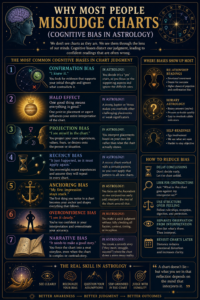
- Critics dismiss it as confirmation bias
- Supporters see it as a psychological or symbolic tool
What’s Changing Now
1. Data and Pattern Recognition
With AI and large datasets:
- Patterns can be analyzed at scale
- Techniques like transits and progressions are being refined
2. Return to Complexity
Modern users are moving beyond Sun signs into:
- Full birth charts
- Synastry
- Predictive techniques
3. Positioning Shift
Astrology is increasingly framed as:
- A tool for reflection
- A symbolic system
- A psychological framework
—not a hard science.
The Core Pattern Across Time
If you zoom out, astrology’s reputation follows a cycle:
- Integration with dominant worldview → trusted
- Conflict with emerging paradigm → challenged
- Adaptation and reinvention → survives
So Where Does Astrology Stand Today?
Astrology today sits in a unique position:
- Not accepted as science
- Not entirely dismissed either
- Widely used, but unevenly understood
Its trust depends on how it is presented:
Low Credibility When:
- Oversimplified (Sun sign only)
- Used deterministically
- Treated as absolute truth
Higher Credibility When:
- Used as a symbolic framework
- Combined with psychology
- Applied thoughtfully and critically
Final Thoughts
Astrology’s journey from Greek philosophy to medieval authority to modern reinvention reveals something important:
Its survival has never depended on being “proven”—but on being useful, adaptable, and meaningful.
Each era reshaped astrology to fit its worldview:
- The Greeks made it philosophical
- The medieval world made it practical
- The modern world made it accessible
Now, in the digital age, astrology faces the same challenge it always has:
Can it maintain depth while adapting to convenience?
Because ultimately, astrology’s reputation is not fixed—it evolves with the people who practice it.